More machines won’t save you. More balance will.
I’m going to say the quiet part out loud: most pick and place line expansion plans fail because people buy the “cool” machine first, then discover the stencil printer can’t keep up, the reflow oven becomes a parking lot, and AOI starts rejecting boards faster than you can rework them. That’s not scaling. That’s just moving pain around the factory.
So let’s talk like adults. Numbers first. Feelings later.
In 2023, the electronics industry stayed the largest customer for industrial robots, taking a big slice of new installs. That’s not trivia. It’s a hint: electronics factories scale when they standardize work and automate the repeatable steps, not when they “add horsepower” blindly. (IFR International Federation of Robotics)
And the automation wave isn’t slowing down. The International Federation of Robotics reported 4,281,585 industrial robots operating worldwide (up 10%), with annual installations above half a million for the third year in a row. That kind of spend doesn’t happen because everyone is bored. It happens because labor, lead times, and quality risk all punish manual growth. (IFR International Federation of Robotics)
But here’s the hard truth. Your SMT line doesn’t care about headlines. It cares about its slowest step.
The bottleneck rule (the one people ignore)
A pick-and-place line is a chain. You pull one link, the next link snaps.
When I see a factory ask, “Should we add a second mounter?”, I ask one question back: What’s your measured bottleneck today—printer, placement, reflow, or inspection? If you can’t answer in 60 seconds with real cycle times, you’re shopping, not engineering.
Want a quick, brutal diagnostic?
- If your printer is the bottleneck, adding another mounter increases WIP, not output.
- If reflow is saturated, your line becomes a conveyor museum.
- If AOI/SPI is behind, defects “ship” into rework queues and kill your takt.
- If feeders and changeovers are the drag, you don’t have a speed problem. You have a setup problem.
This is where SMT line balancing and bottleneck analysis pays for itself. Not with vibes. With minutes.
What “add equipment” really means in 2026
“Add equipment” usually means one of four moves:
- Add placement capacity
- Add printing stability
- Add thermal throughput
- Add inspection capacity (and reduce escapes)
You can do all four. Just not in the wrong order.
And yes, vendors love to sell you the shiny thing. Rockwell literally talks about expanding factories and workforce to push more automation into manufacturing. That’s their job. Your job is to not buy a mismatch. (Reuters)
The practical playbook: scale in the order that protects flow
1) Lock your paste process before you chase CPH
If you’re planning a stencil printer upgrade for higher volume, don’t treat it like a “nice-to-have.”
Printing drives:
- defect rate (bridges, opens, tombstones),
- downstream rework load,
- AOI false calls,
- and, quietly, your real throughput.
If you’re scaling, stop guessing and run SPI feedback like you mean it. If you’re missing SPI, you’re flying without instruments.
If you need the bigger picture, start with turnkey SMT line solutions and map the whole chain before you buy a single box.
2) Add placement only when placement is proven to be the limit
This is where people ask: “Can we add a pick and place machine to an existing line?” Yes. Often. But the “often” depends on feeders, program control, and material handling.
Adding a second placement machine can work if:
- your feeder bank supports parallel loading,
- your changeover method doesn’t double the chaos,
- and your line control doesn’t create starvation/blocking cycles.
If you’re doing high-mix, the smarter “equipment” add might be feeder strategy, carts, and offline kitting—boring stuff that prints money.
If your product mix is messy, look at mixed SMT lines instead of pretending you’re a pure high-volume line.
3) Treat reflow like a capacity ceiling, not a heater
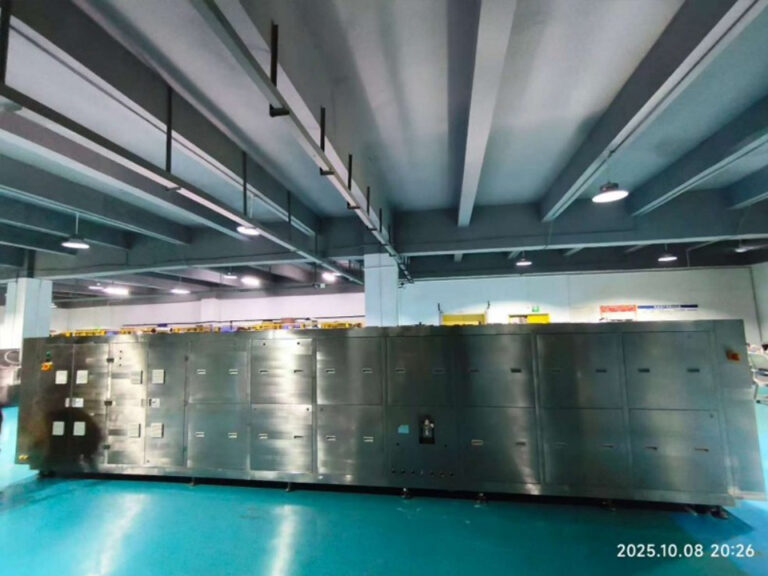
A lot of teams discover too late that reflow oven capacity for scaled production isn’t about peak temperature. It’s about conveyor loading, zone recovery, nitrogen flow (if used), and board spacing rules.
Here’s the nasty pattern:
- You add placement speed.
- Boards stack.
- Operators widen spacing “to be safe.”
- Output drops.
- Everyone blames the new machine.
So. Measure your reflow throughput in boards/hour at your real recipe. Then decide if you need a second oven, a dual-track setup, or process changes that reduce time above liquidus without risking defects.
If you’re scaling into real volume, browse high-speed mass production lines and compare layouts that keep reflow from becoming your silent limiter.
4) Scale inspection before your customers scale your returns
AOI and SPI are not “quality departments.” They are throughput governors once volume climbs.
If you’re adding capacity, budget for AOI/SPI inspection equipment for scaling early, not after field failures teach you humility.
And please don’t pretend AOI alone is enough. SPI catches paste problems upstream, before you waste placement time. That’s not theory. That’s cash.
If you want proof patterns, check customer cases and look for the same sentence repeating: “We improved yield before we improved speed.”
A table you can actually use
| Scaling goal | What you add | When it works | When it backfires | What to measure first |
|---|---|---|---|---|
| More output (boards/hour) | Second pick-and-place / extra placement head | Placement is the verified bottleneck | Printer/reflow/inspection can’t feed or clear | Placement utilization %, feeder idle time, starvation/blocking |
| Lower defects at higher volume | SPI + tighter print control | Paste is driving escapes or rework | You ignore feedback and treat SPI as “reporting” | Paste volume Cpk, bridge/open rate, rework minutes/board |
| Higher thermal throughput | Second reflow / dual-track / recipe optimization | Reflow is saturated at real spacing | You “speed up” and create voids/head-in-pillow | Conveyor loading %, boards/hour at recipe, defect Pareto |
| Faster changeovers (high-mix) | Feeder carts, offline kitting, standardized setups | Changeover dominates downtime | You add machines but keep manual chaos | Changeover time, setup errors, kit completeness rate |
| Fewer escapes at scale | AOI capacity + smarter review rules | AOI is the gate that keeps flow safe | False calls explode and operators bypass | False call rate, review time, escape rate, rework queue size |
The part nobody budgets for: people and ramp time
Scaling hardware without scaling skill is how you get “new line, old mistakes.”
Training isn’t optional when you add:
- a second mounter,
- a new inspection stage,
- or a new process window.
If you’re serious, tie equipment adds to competency adds. Use training and after-sales support as part of the capex plan, not as a rescue call after the first ugly week.
Also: schedule a real ramp. Not a fantasy ramp. Your first month is always slower than your spreadsheet.
FAQs
1) How do I scale a pick and place setup without creating new bottlenecks?
Scaling a pick and place setup means increasing total line output by adding capacity at the true constraint (printer, placement, reflow, or inspection) while keeping upstream feed and downstream clearance balanced, so higher speed doesn’t turn into more WIP, more rework, and more downtime. Start with measured cycle times, then add equipment in constraint order.
If you don’t know the constraint, time each stage for a full shift and look for the step with the highest utilization and longest recovery after stops. That’s where expansion pays.
2) What’s the fastest way to do an SMT line capacity upgrade?
An SMT line capacity upgrade means raising boards-per-hour by removing the current limiting step through targeted equipment additions, process tuning, or parallelization, instead of “speeding up everything” and hoping the line behaves. The fastest upgrades usually come from printer stability (with SPI), changeover reduction, or reflow throughput fixes.
Adding a second mounter looks fast, but it’s only fast when placement is the real limit and the rest of the line can feed it.
3) Can I add a pick and place machine to an existing line and see immediate gains?
Adding a pick and place machine to an existing line means increasing placement capacity by running two placement stages in series or parallel while keeping feeders, programs, and board handling synchronized so the new machine doesn’t starve or block the line. You’ll see immediate gains only if placement was the verified bottleneck and changeovers don’t explode.
If your printer or reflow is already near saturation, the “gain” becomes extra WIP and extra operator stress.
4) When should I do a stencil printer upgrade for higher volume?
A stencil printer upgrade for higher volume means improving paste deposition consistency and print cycle stability so yield stays high as takt time drops, preventing paste-driven defects from multiplying downstream and consuming placement and inspection capacity. Do it when paste defects dominate your Pareto, or when you’re pushing cycle time and print quality starts drifting.
If you scale volume while paste control is unstable, you’re scaling scrap.
5) Do I need AOI and SPI when scaling production?
AOI and SPI for scaling production means using inspection to catch defects early (SPI for paste, AOI for placement/solder appearance) so volume growth doesn’t increase escapes, returns, and rework queues that crush throughput. You “need” them when defects cost more than inspection time—at scale, they usually do.
SPI is the upstream control lever. AOI is the downstream safety net. Treat both like line tools, not paperwork.
Conclusion
If you’re planning pick and place line expansion, don’t buy equipment based on hope. Map your bottleneck, pick the constraint, and scale the line like a system. If you want a done-right plan (equipment list, layout logic, ramp checklist), start with the Download Catalog and then reach out through the Contact page so we can match your volume target to the right line architecture.