Precision is political.
In high-end machines, nobody admits that alignment is the weak link because misalignment sounds too basic, too mechanical, too “maintenance department” for a factory buying Yamaha, Fuji, Panasonic, Hanwha, Juki, DEK, Heller, Koh Young, Mirtec, or Saki-level equipment. But what actually kills output? Tiny geometry errors. Thermal drift. Shaft offset. Rail deviation. Camera-to-nozzle mismatch. Board-transfer skew. A machine that looks clean on the brochure and lies under load.
That costs money.
Laser Alignment Systems are not accessories; they are measurement weapons for factories that cannot afford invisible error. In SMT production, semiconductor tooling, CNC machining, optical inspection, reflow handling, and robotic assembly, the old “good enough by fixture” culture is dying because the tolerances are no longer forgiving. SEMI projected global semiconductor capacity to pass 30 million wafers per month in 2024, after 29.6 million wafers per month in 2023, which tells us one thing clearly: precision throughput is becoming a capacity weapon, not a luxury feature. SEMI’s January 2024 World Fab Forecast explains that pressure in hard numbers. (Semi)
So why do so many factories still treat alignment like a commissioning checkbox?
Because misalignment hides. It hides behind “operator variation,” “bad components,” “PCB warpage,” “nozzle wear,” “paste issue,” “camera issue,” and my personal favorite: “the machine is old.” Sometimes the machine is not old. Sometimes it is geometrically dishonest.
For SMT buyers comparing pick and place machines, the smarter question is not only placement speed or feeder count. It is: how is the machine aligned, verified, stabilized, recalibrated, and proven after months of vibration, heat cycles, transport, replacement parts, and emergency repairs?
The hard truth about high-end machine alignment
A premium machine can still produce mediocre results if its geometry is drifting. Laser alignment methods matter because they replace opinion with traceable measurement: straightness, flatness, parallelism, squareness, coaxiality, shaft position, rotational centerline, nozzle-camera relationship, rail transfer path, and multi-axis positional behavior.
In plain English: the machine must know where it is.
Reuters reported in February 2024 that the U.S. semiconductor law included $52.7 billion overall, with $39 billion in production subsidies and $11 billion for semiconductor R&D, which matters because public money is not flowing toward “cheap enough” factories; it is flowing toward advanced manufacturing capacity where measurement discipline decides yield. Reuters’ CHIPS reporting is a useful macro signal. (Reuters)
And the same logic applies downstairs on the SMT floor.
If your line runs prototype boards, automotive electronics, medical devices, aerospace assemblies, dense LED boards, or advanced communication modules, alignment is not a maintenance ritual. It is yield insurance. For mixed-product factories, mixed SMT lines need especially tight alignment control because changeovers punish weak baselines.
What laser alignment systems actually measure
A good industrial laser alignment system does not “make the machine precise.” It exposes whether the machine deserves your trust.
The system projects a laser reference and measures deviation through detectors, position-sensitive sensors, cameras, reflectors, interferometers, or target receivers. Depending on the machine, it can verify whether two shafts share a centerline, whether a guide rail is straight, whether a gantry axis is square, whether a spindle travels honestly, or whether a transfer section is forcing boards into micro-skew before placement or inspection.
I’ll be blunt: the machine that passes a casual mechanical check can still fail a laser-based geometry check.
That is the point.
In 2024, a Nature Communications paper showed that 3D misalignment between distant objects could be measured using metasurface alignment marks, a laser, and a camera with sub-nanometer precision under the reported method. The Nature Communications study is not a shop-floor SMT manual, but it shows where precision measurement is going: laser-plus-camera alignment is becoming far more sensitive than legacy visual methods. (Nature)
Where laser alignment systems matter in SMT and high-end machines
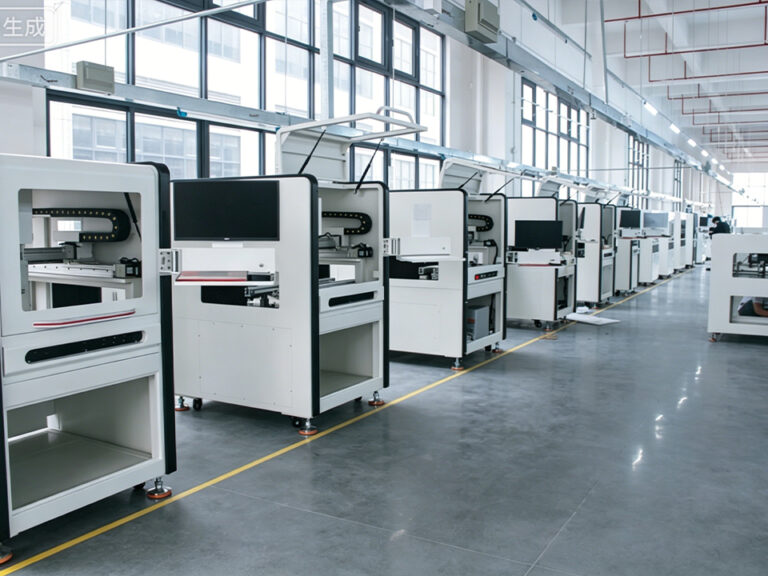
On a high-end SMT line, alignment problems rarely stay in one box. A small conveyor skew creates board-position error. Board-position error pressures the printer. The printer error affects solder volume. The placement machine corrects some of it with vision, then AOI flags “random” defects. Then the team blames paste, nozzles, operators, or humidity.
But the line was crooked.
A factory planning turnkey SMT line solutions should treat laser alignment as part of line architecture, not as an after-sales rescue procedure. The best use is preventive: verify the line before production, after relocation, after impact, after major maintenance, after feeder-bank replacement, after conveyor service, and after unexplained defect spikes.
For high-speed factories, high-speed mass production lines make alignment even less forgiving. At volume, a 0.05 mm systematic error is not a small error; it is a repeatable profit leak.

The three alignment cultures I see in factories
Some factories buy machines. Better factories buy processes. The best factories buy evidence.
| Factory Culture | How Alignment Is Treated | Common Result | Better Method |
|---|---|---|---|
| Reactive maintenance | Alignment is checked after defects rise | Long downtime, blame cycles, unstable yield | Use laser alignment after any crash, relocation, or unexplained defect trend |
| Commissioning-only | Alignment is checked at installation, then forgotten | Slow drift becomes “normal” | Schedule quarterly or semiannual geometry verification |
| Process-quality driven | Alignment is treated as a controlled variable | Faster root-cause analysis, stronger repeatability | Connect laser alignment data with AOI/SPI/placement/reflow records |
| High-end automation | Alignment is integrated into machine qualification | Lower risk during expansion and mixed production | Use laser methods during acceptance testing and line balancing |
This is why process quality should not be a slogan. It should include a hard record of machine geometry, line-level repeatability, calibration intervals, and maintenance triggers.
The advanced methods: not all laser alignment is equal
Basic shaft alignment is useful. But high-end machine alignment goes further.
Straightness measurement checks whether a rail, gantry, or axis moves in a true path. Squareness measurement checks whether X and Y axes behave like a real coordinate system, not a polite approximation. Flatness measurement checks whether a mounting plane, table, or machine bed is distorting the process. Laser interferometry can measure positional error, backlash, and repeatability across travel. Camera-assisted laser systems can track targets and detect micro-movement under thermal or mechanical stress.
That last part matters.
A machine may align cold and misbehave hot. It may pass at 9 a.m. and drift by second shift. It may meet tolerance unloaded and bend under real production load. That is why alignment should be tested under conditions close to production reality whenever possible.
A 2024 laser-system automation case study compared neural-network, practice-led, and design-led approaches for automating laser alignment, and found that different methods require different knowledge bases, resource levels, and measurement-sampling budgets. The case study on automated laser system alignment gives a useful warning: automation does not remove alignment expertise; it changes where that expertise has to live. (arXiv)
Laser alignment equipment versus old-school alignment
Here is the uncomfortable comparison.
| Method | Strength | Weakness | Best Use |
|---|---|---|---|
| Dial indicator | Cheap, familiar, rugged | Operator-dependent, slower, limited data capture | Simple shaft checks, low-volume maintenance |
| Straightedge / feeler gauge | Fast and basic | Too crude for high-end machines | Rough pre-checks only |
| Optical level / autocollimator | High accuracy in trained hands | Requires skill, setup discipline, interpretation | Precision machine geometry checks |
| Laser alignment system | Fast, digital, repeatable, data-friendly | Requires correct setup and trained interpretation | SMT lines, rotating equipment, gantries, machine tools |
| Laser interferometer | Very high positional measurement capability | Higher cost, more specialized | CNC, semiconductor, ultra-precision axes |
Cheap tools are not evil. Misused cheap tools are.
For spare parts, feeder systems, nozzles, belts, rails, and machine service, maintenance and spares should be connected to alignment data. Replacing parts without checking geometry is like replacing tires without checking wheel alignment.
How laser alignment systems improve machine precision
Laser alignment systems improve machine precision by converting hidden geometric error into measurable correction data. They help technicians identify offset, angular misalignment, straightness error, squareness error, flatness deviation, vibration-related drift, and thermal movement before those errors appear as yield loss, defective placement, premature bearing wear, or inspection noise.
That is the clean answer.
The harsher answer is this: laser alignment systems reduce the number of excuses available to a production team. Once you can measure machine geometry, you can no longer hide behind vague language like “probably mechanical” or “maybe calibration.” You know. Or at least you know where to look next.
Buying logic: what to ask before choosing laser alignment equipment
Do not buy laser alignment equipment because the brochure says “high precision.” Ask what precision means. Is it ±0.001 mm, ±0.01 mm, or marketing fog? Ask whether the system supports your machine type: rotating shafts, SMT conveyors, gantry axes, CNC beds, optical systems, reflow transfer, inspection platforms, or feeder-related assemblies.
Ask these questions before purchase:
Can it store reports with timestamps and operator IDs? Can it measure under real factory conditions? Can it export data for quality records? Can it support your equipment brands and machine sizes? Can your technicians repeat the setup without vendor babysitting? Can it separate machine error from fixture error?
And one more: who will own the data?
Because in a serious factory, alignment data belongs beside SPI, AOI, placement accuracy, reflow profile, maintenance logs, and customer complaint records. It should not live on one engineer’s laptop with a filename like “new alignment final final 2.xlsx.”
FAQs
What are Laser Alignment Systems?
Laser Alignment Systems are measurement tools that use a laser reference beam, sensors, cameras, targets, or reflectors to detect geometric deviation in machines, shafts, rails, beds, gantries, optical assemblies, and production lines so technicians can correct misalignment with measurable, repeatable data rather than visual judgment.
In high-end machines, they are used to verify straightness, squareness, parallelism, flatness, coaxiality, and positional behavior. The goal is not only smoother operation. The goal is repeatable production accuracy.
How do laser alignment systems improve machine precision?
Laser alignment systems improve machine precision by identifying small mechanical and geometric errors before they become placement defects, bearing wear, transfer instability, vibration, soldering variation, or inspection noise across production equipment operating under speed, load, and thermal change.
In SMT lines, this can mean more stable board transfer, better placement repeatability, cleaner AOI data, fewer false root-cause assumptions, and faster troubleshooting when defects appear after maintenance or relocation.
Are laser alignment methods better than dial indicators?
Laser alignment methods are usually better for high-end machines because they provide faster setup, digital readings, repeatable measurements, stored reports, and stronger visibility into angular and offset errors compared with manual dial-indicator methods that depend heavily on operator skill.
Dial indicators still have value. I would not throw them away. But for advanced machine alignment, especially where traceability and repeatability matter, laser-based measurement gives the maintenance team a better evidence trail.
When should industrial laser alignment be performed?
Industrial laser alignment should be performed during installation, after machine relocation, after impact or crash events, after major maintenance, after replacing motion-related parts, during scheduled preventive maintenance, and whenever defects rise without a clear process-material explanation.
For high-speed SMT production, I would also check alignment after repeated conveyor jams, unexplained AOI defect clusters, recurring nozzle-camera correction issues, and suspicious placement drift across multiple product runs.
What machines benefit most from precision laser alignment systems?
Precision laser alignment systems benefit machines where small geometric errors create large production losses, including SMT pick-and-place machines, solder paste printers, AOI/SPI inspection systems, CNC machine tools, robotic assembly cells, conveyor systems, rotating equipment, laser cutting machines, and semiconductor-related handling systems.
The highest return usually appears where three things meet: tight tolerance, high speed, and expensive downtime. That is why advanced electronics manufacturing is a natural fit.
Final word
Laser alignment is not glamorous. Good. Glamour does not hold ±0.02 mm.
If your factory is buying or upgrading SMT equipment, do not treat alignment as a side note buried under speed, feeders, cameras, and brand names. Ask for geometry evidence. Ask for service discipline. Ask how alignment is verified after the machine leaves the showroom and starts living in the real world.
For machine selection, line planning, service support, or factory-specific alignment concerns, talk with the team through contact support before the defect trend becomes your production schedule.