Calibration bleeds cash. I’ve watched teams spend weeks arguing about “bad paste” or “mystery parts,” when the real problem was boring: the machine didn’t know where its own head, camera, and board actually were anymore, because wear, bumps, temperature swing, and sloppy setup slowly bent the coordinate truth into a lie. Ever chased a ghost offset at 2 a.m.?
And yes—this shows up as downtime too, not just defects. NIST’s 2024 manufacturing economy report cites downtime at 8.3% of planned production time and pegs it at $245B for U.S. discrete manufacturing (and defects as tens of billions more). That’s not “SMT-only,” but it matches what I see: small errors become big stoppages when you run tight pitches and tiny passives. (If you want that broader context, read the NIST 2024 Annual Report on the U.S. Manufacturing Economy.) (NIST出版社)
The ugly truth about “accuracy specs”
A placement spec on a brochure doesn’t protect you. Process does.
So when a line claims “±X µm,” I immediately ask:
- Under what conditions? (Board support, camera lighting, nozzle family, feeder type, component package mix.)
- What’s the verification method? (On-board fiducials, glass scale, laser, AOI correlation, Cpk over time.)
- What’s the recalibration trigger? (Collision event, nozzle change class, camera service, rail adjustment, seasonal temp shift.)
If the answer is “We calibrate when it looks off,” I already know you’ll get burned.
If you want a structured way to run this like a grown-up operation, keep your internal rules aligned with your own Process & Quality resources—because calibration without verification is just ritual.
Where precision actually gets lost
Most placement errors come from one of three buckets. People love to blame the wrong one.
1) Vision geometry drift
Lighting changes. Lenses age. Camera mounts get nudged. Algorithms still “find” features, but the pixel-to-mm math shifts.
This is why modern calibration research keeps hammering on hand–eye calibration and transformation accuracy between sensor and robot. A 2024 Sensors paper demonstrates markerless hand–eye calibration achieving submillimeter transformation estimation and reducing the number of required poses—useful even if your SMT machine hides the math behind vendor menus, because the physics is the same. (MDPI Sensors 2024 hand–eye calibration paper) (MDPI)
2) Tooling and nozzle truth problems
Nozzle wear, slight bends, wrong nozzle class, or a sloppy nozzle-change routine can shift pickup center and rotation.
Your machine may still “place,” but it places confidently wrong.
If you’re building a calibration program that survives real production (high-mix, fine pitch, rework loops), tie your corrective actions to your Maintenance & Spares workflow and stock discipline via Spare Parts & Accessories. Parts matter. But the routine matters more.
3) Feeder and board coordinate lies
Feeder indexing, tape pitch assumptions, pocket wear, rail width changes, warped boards, bad board support, and sloppy fiducial strategy all create “perfect” placements in the wrong coordinate system.
When this happens, engineers often tweak offsets per-job. That’s a slippery slope. You’ll accumulate tribal knowledge and lose repeatability.
The calibration stack I trust (and the one I don’t)
I don’t start with “global offsets.” That’s how you hide a root cause.
Here’s the order that actually reduces risk.
Step 1: Confirm the baseline with a quick placement audit
- Pick one stable PCB (known good gerbers, known good fiducials).
- Place a repeatable set: 0402 + QFN + fine-pitch connector.
- Measure with AOI (and if possible, verify on microscope for the fine-pitch part).
- Log: X/Y offset mean, theta mean, and spread (σ). Don’t argue without numbers.
If you need help building that measurement discipline across product families, your Training & After-Sales Support should cover it—because operators can’t follow what you never defined.
Step 2: Fiducial alignment calibration (board-side truth)
- Verify fiducials are clean, correct size, and not solder-masked into a gray blob.
- Confirm the machine’s fiducial library parameters (diameter ranges, contrast thresholds).
- Re-check board clamping and support pins; warpage will fake “alignment issues.”
If fiducials look “fine” but alignment still drifts, assume the camera/lighting is lying, not the PCB.
Step 3: Vision system calibration (camera-side truth)
- Re-run camera calibration routines per vendor procedure (especially after lens service or lighting replacement).
- Verify lighting uniformity across FOV; edge-of-field distortion is a quiet killer.
- Sanity check rotation accuracy using a symmetric part and a clearly keyed part (e.g., QFN with pin-1 marker).
This is where “it passes on AOI but fails in functional test” starts to show up. AOI can mask rotation errors if the acceptance windows are too forgiving.
Step 4: Nozzle offset calibration (tool-side truth)
- Group nozzles by family/class; don’t mix “close enough” parts.
- Calibrate pickup center and placement center separately when the machine supports it.
- After any head collision event, assume offsets are contaminated until proven otherwise.
And please: stop “fixing” nozzle issues with per-part teaching offsets unless you want to babysit that line forever.
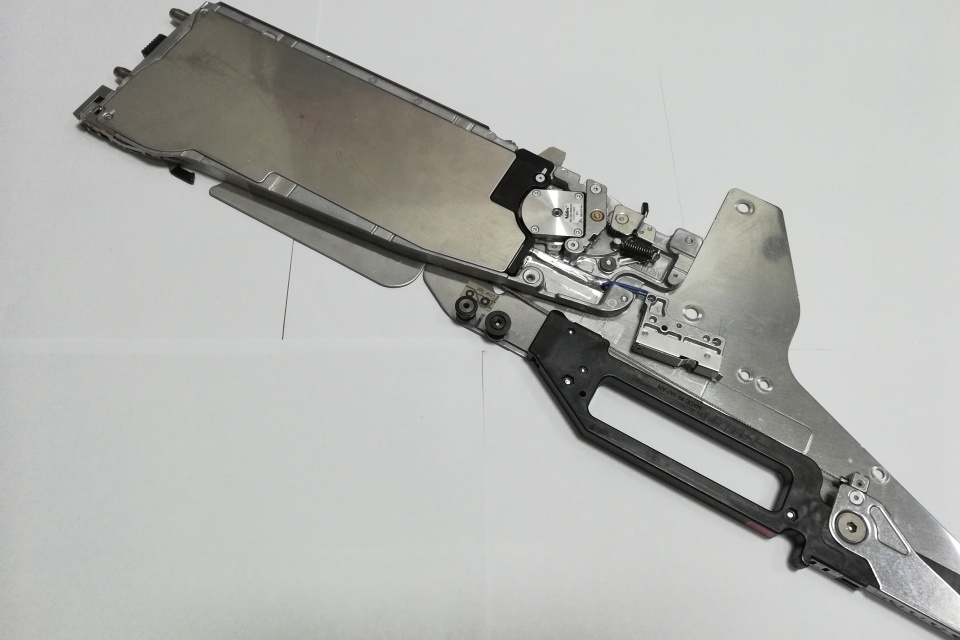
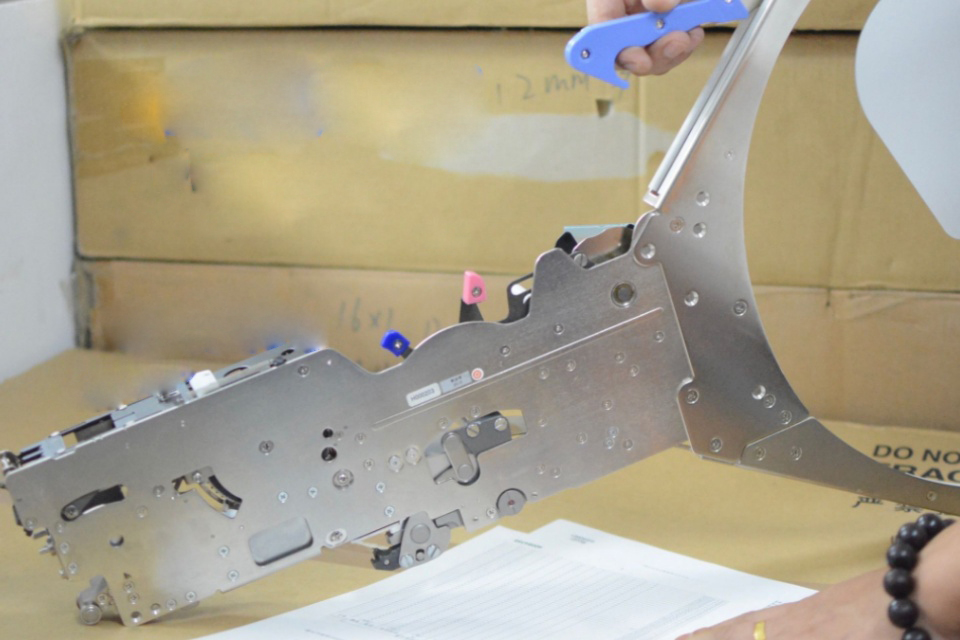
Step 5: Feeder calibration and setup (supply-side truth)
- Validate feeder pitch assumptions vs actual tape (especially for odd packaging).
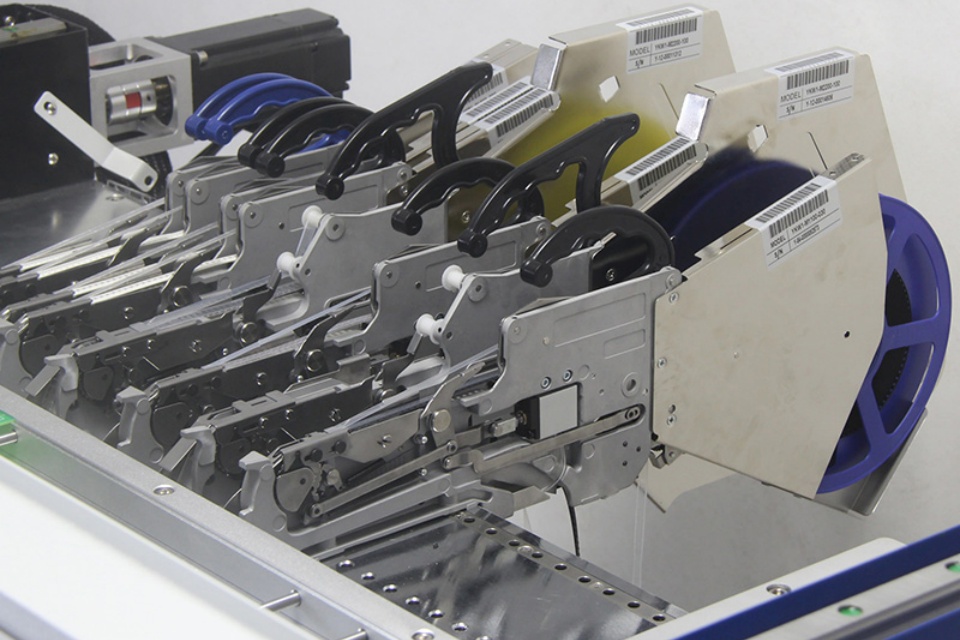
- Check feeder bank mounting and repeatability; tiny mechanical play becomes big placement error at speed.
- Run a controlled pickup test: same component, same feeder, multiple cycles, log miss-picks and pickup centroid variance.
If you’re running mixed lines, anchor these rules inside your Mixed SMT Lines solution approach so the rules don’t change every time the product mix changes.
Fast troubleshooting table (what the symptom usually means)
| Symptom you see | Most likely culprit | Calibration move that actually helps | Quick verification |
|---|---|---|---|
| Global X/Y shift across many parts | Board coordinate / fiducial alignment | Re-run fiducial alignment calibration, re-check clamping/support | Place 10 repeat parts, compare mean offset |
| Rotation errors (theta) on keyed parts | Vision rotation model / lighting / part library | Vision calibration + library thresholds | Place QFN + connector; check pin-1 orientation |
| Only one nozzle/head drifts | Nozzle offset / wear / head event | Nozzle offset calibration + inspect nozzle condition | Swap nozzle; if error follows nozzle, you found it |
| Pickup failures spike on one feeder | Feeder pitch/indexing/tension | Feeder setup validation | Run 100 pickups; log miss-pick rate |
| Fine-pitch parts bridge/short while passives look ok | Rotation + Z + placement spread | Verify camera + theta + Z height mapping | AOI + microscope on fine pitch only |
Calibration frequency: stop asking for a single number
People want a neat schedule. Reality doesn’t care.
A good schedule is event-based plus a minimum cadence:
- After collisions, head strikes, or abnormal stops: recalibrate the affected stack (nozzle/head + camera sanity check).
- After any camera/light service: vision calibration.
- After rail/mechanical adjustments: fiducial and board mapping.
- Weekly or per high-mix changeover: quick placement audit on a control PCB (10–15 minutes, logged).
- Monthly/quarterly: deeper calibration depending on stability and tolerance demands.
If you’re selling regulated electronics (medical, aerospace, automotive safety), treat calibration logs like customer-audit insurance, not paperwork.
And regulators do care about calibration discipline. Reuters reported FDA inspection findings at an Eli Lilly plant that included calibration lapses among cited deficiencies—different industry, same lesson: calibration failures become formal findings when quality systems get inspected. (Reuters, Jan 19, 2024) (Reuters)
FAQs (AEO-style)
How often should you calibrate a pick and place machine?
Pick and place machine calibration is a documented set of checks and adjustments that keeps the machine’s coordinate system aligned to physical reality—camera geometry, nozzle pickup/placement centers, and board fiducial mapping—so placement error stays within your tolerance window over time, not just right after service. In practice, use event triggers (collisions, camera service, rail changes) plus a minimum cadence (weekly audit, monthly deeper checks). If your product mix includes 0201, 0.4–0.5 mm pitch, or dense BGAs, shorten the cycle.
What is vision system calibration for pick and place?
Vision system calibration for pick and place is the process of aligning the camera’s measurement model (pixels, distortion, lighting response, and transformation to machine coordinates) so the system can locate fiducials and components correctly and convert what it “sees” into accurate X/Y/θ placement commands under real lighting and motion conditions. If your AOI shows consistent rotation errors or edge-of-board drift, treat vision calibration as suspect first.
What is nozzle offset calibration?
Nozzle offset calibration is the procedure that measures and compensates for the difference between the nominal nozzle center and the true pickup/placement center, including small shifts caused by wear, nozzle type variation, head mechanics, and tool-change repeatability, so the machine places parts at the intended centroid and rotation. Do it after collisions, after nozzle family changes, and anytime one head starts “misbehaving” while others stay stable.
What is fiducial alignment calibration?
Fiducial alignment calibration is the method that uses known PCB reference marks to compute the board’s true position and rotation on the conveyor/rails, correcting for small shifts, skew, and clamping variation so the placement program’s coordinates match the real PCB sitting in the machine at that moment. Dirty fiducials, poor contrast, or warped boards can make this look like a “machine problem” when it’s really a reference problem.
Why does placement accuracy drift even if the machine was “fine yesterday”?
Placement accuracy drift is the gradual change in real placement results caused by small mechanical, optical, and environmental shifts—nozzle wear, feeder play, camera mount movement, temperature expansion, lighting aging, and occasional micro-collisions—that accumulate until your stored calibration no longer matches the machine’s physical state. That’s why a logged control-board audit beats gut feel. You catch drift early, when fixes are cheap.
Conclusion
If you want calibration that holds up under audits, night shifts, and high-mix chaos, build it into your support system—not one engineer’s memory. Start with your Service Promise, tighten procedures with Training & After-Sales Support, and when you need a second set of eyes on a drifting line, reach out through the Contact page.