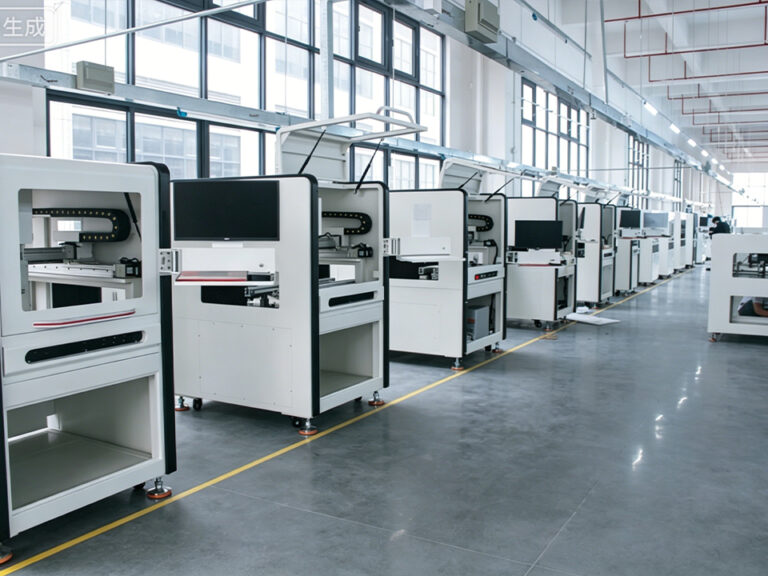
Fast looks good. But in SMT, speed by itself proves almost nothing. A placement head can look excellent in a demo, then start leaking accuracy once feeder pitch shifts, nozzle wear builds up, board warp shows up, and tiny rotation errors begin stacking across a long run.
That is where real-time feedback systems stop being a nice feature and start being the control layer that keeps production honest. The machine is not just moving. It is checking, comparing, correcting, and trying to stop a small miss from becoming a line-wide defect. That is the real story behind modern self-correcting machines.
Why Real-Time Feedback Systems Matter in Modern Placement
The hard truth is simple: a fast machine without feedback is just a faster way to make scrap.
According to the IFR World Robotics 2024 release, factories worldwide had 4,281,585 industrial robots in operation in 2023, with 541,302 new installations that year. Reuters also reported in 2024 that China reached 470 robots per 10,000 workers, Germany hit 429, and South Korea led with 1,012. Automation is scaling fast. The real question now is not who owns more machines. It is who controls them better.
In placement work, drift is normal. Feeders shift. Nozzles age. Boards are not perfectly flat. Operators rush setups. So the issue is not whether variation exists. It does. The issue is whether the machine can detect that variation and react before yield gets hit.
What Real-Time Feedback Systems Actually Do
A pick and place feedback system compares target motion with actual motion.
That sounds basic. It is basic. But it is also the whole point.
If the placement head misses position, encoders catch it. If pickup is off-center, cameras catch it. If the PCB shifts, fiducials catch it. If height changes across the board, Z compensation should catch it. Then the controller applies a correction before the part lands wrong.
NIST made the same point in its 2024 manufacturing robotics report. Broader use of advanced industrial robots depends on stronger measurement, perception, machine vision, and control validation. In plain language, smarter production requires machines that can sense, verify, and react in real time.
How Modern Machines Self-Correct During Placement
Modern machines usually correct themselves in layers.
First, they verify pickup. Then, they verify motion. Then, they verify alignment and rotation just before placement.
This is where real-time machine vision matters. The system checks part centering, board fiducials, and head position, then trims X/Y or theta before final placement. Better systems also track repeat errors. If the same nozzle, feeder, or board zone keeps causing misses, good software should stop calling it random and start treating it like a process issue.
That is machine self-correction during placement in the real factory. Not a brochure phrase. A control habit.
Core Components Inside a Pick and Place Feedback System
A serious feedback stack usually depends on five things:
- vision systems for fiducials, centering, and rotation checks
- motion feedback from encoders and servo loops
- height control for Z-axis and board variation
- software logic that turns measurement into correction
- process memory that flags repeat deviation over time
And this is where many buyers misread the problem. They judge the mounter alone, even though the result depends on the line around it. That is why teams planning turnkey SMT line solutions also care about the SMT inspection system and solid training and after-sales support.
Where Placement Accuracy Control Fails in the Real World
Most placement failures are boring. That is why people underestimate them.
Feeders slip. Nozzles get dirty. Vacuum response changes. Calibration drifts. Boards warp. Operators move too fast during setup. Then the factory acts surprised when the machine starts placing slightly off.
I think that is the real divide in this business. Experienced teams assume drift exists. Inexperienced teams act shocked by it.
NIST’s Digital Twins for Advanced Manufacturing work makes the broader lesson pretty clear: digital twins can help manufacturers observe, diagnose, predict, and optimize systems in near real time, but only when live machine data is reliable and connected. If feedback stops at one machine, the line is not really intelligent. It is just isolated.
Open-Loop vs Closed-Loop Feedback Systems in SMT
Let’s keep it simple.
Open-loop systems follow stored instructions and assume the machine behaves as expected. Closed-loop systems keep checking reality and correcting based on live conditions.
| System type | What it trusts | How it handles drift | Best fit |
|---|---|---|---|
| Open-loop placement | Stored coordinates and setup | Little or no in-cycle correction | Stable, simple jobs |
| Basic closed-loop placement | Encoders, fiducials, centering cameras | Corrects common motion and alignment errors | Standard SMT production |
| Advanced self-correcting machines | Vision, encoders, height sensing, inspection feedback | Corrects in-cycle and tracks repeat patterns | High-mix, tight-tolerance lines |
That is why closed-loop feedback systems dominate serious precision work. They do not assume. They verify.
Real-World Benefits of Machine Self-Correction During Placement
The first benefit is yield.
The second is cleaner root-cause analysis. A machine with better feedback tells you why it is drifting. A weak one just gives you bad boards later.
The third is stability across product mix. On prototype small-batch lines, feedback reduces setup noise. On high-speed mass production lines, it stops tiny repeat errors from turning into real cost.
A useful 2023 example comes from Development of a vision-based automated hole assembly system with quality inspection. The researchers used dual cameras, computer vision, and control logic to handle peg insertion with 200 µm tolerance while adding real-time inspection. The lesson is simple: sense, compare, correct, verify.
Best Real-Time Feedback Systems for Placement Accuracy: What Buyers Should Evaluate
Start with sensor coverage. Not slogan coverage.
Can the machine verify pickup quality? Can it correct X/Y and theta in-cycle? Can it handle board-height variation? Can it turn repeat errors into maintenance logic? Can inspection data feed back into process control?
Those questions matter more than flashy sales language. A camera alone is not enough. A fast head alone is not enough. A good system must measure, react, and learn.
FAQs
What are real-time feedback systems in placement machines?
Real-time feedback systems in placement machines are closed-loop control setups that use cameras, encoders, sensors, and software to compare commanded movement with actual machine behavior in milliseconds, then apply corrections before final placement. In SMT, they reduce drift, placement offset, and repeatable errors before defects move downstream.
How do machines self-correct during placement?
Machines self-correct during placement by measuring pickup position, head motion, board alignment, part centering, and height conditions in real time, then adjusting axis position, rotation, or placement behavior during the same cycle. Better systems also store repeat error patterns and use them to improve maintenance and setup control.
What is the difference between open-loop and closed-loop feedback systems?
Open-loop systems follow pre-set coordinates without checking the actual result during each cycle, while closed-loop feedback systems measure real machine behavior and adjust movement whenever they detect mismatch, drift, or changing conditions. Put simply, open loop assumes and closed loop checks.
Does real-time machine vision alone guarantee placement accuracy?
Real-time machine vision alone does not guarantee placement accuracy because the camera only provides measurement data; correction still depends on motion control, calibration, mechanical stability, and how quickly the controller turns detection into action. Vision can see a miss, but it cannot fix weak mechanics by itself.
When should an SMT factory invest in a more advanced pick and place feedback system?
An SMT factory should invest in a more advanced pick and place feedback system when product mix is high, package tolerances are tight, board warp is common, changeovers are frequent, or defect costs are high enough that in-cycle correction saves more money than a simpler setup. That point usually comes earlier than many managers expect.
If you are evaluating equipment now, do not get distracted by speed alone. Look at sensing depth, correction logic, drift behavior, inspection integration, and support quality. You can review customer cases, explore the pick-and-place machine range, or contact the team for a more grounded discussion.