Big parts expose weak machines.
I’ve seen buyers obsess over placement speed, CPH numbers, and glossy machine brochures, only to lose production time because one oversized connector, relay, shield can, or power module would not release cleanly from the nozzle. That is the hard truth about any pick and place machine: tiny chips are rarely the real enemy. The awkward parts are.
And why does that matter?
Because large component handling is not only a mechanical issue. It is a feeder issue, a nozzle issue, a vision issue, a PCB support issue, and sometimes a supplier-honesty issue. A machine can place 0402s beautifully and still struggle with a 45 mm connector or a heavy transformer.
Global factories are automating faster, and the International Federation of Robotics noted record industrial robot use in its World Robotics 2024 report. But automation only pays when the equipment is matched to the parts that actually cause trouble.
What large component handling really means
Large component handling is the process of reliably feeding, picking, aligning, moving, and placing oversized or heavy SMT components without damaging the part, stressing the PCB, or slowing the line.
Simple definition. Hard execution.
In SMT, “large” does not always mean huge. It can mean too tall, too heavy, too reflective, too soft, too irregular, or too difficult to feed consistently. Common problem parts include tall capacitors, relays, RF shields, large connectors, transformers, inductors, LED modules, metal housings, and hybrid power modules.
A smart pick and place machine selection starts with the worst component on the board, not the easiest one.
The hard truth about oversized part pick and place
Most oversized part failures come from five areas: unstable pickup, poor vision recognition, nozzle mismatch, PCB flex, or bad line sequencing.
That’s it.
The machine often gets blamed, but the real cause is usually weak process planning. Someone assumes a large connector can run like a standard chip package. Someone ignores center of gravity. Someone accepts “supported component size” without asking how it is supported.
Here is my blunt opinion: if a supplier cannot discuss component weight, maximum height, nozzle design, feeder method, placement force, board support, and changeover time in one conversation, they are not selling a process. They are selling hope.
And hope is not production control.
Why oversized parts punish weak automation
A large component has more mass, more surface variation, and more opportunity to shift during movement. If head acceleration is too aggressive, the part can rotate. If vacuum coverage is poor, it may move before placement. If the pickup surface is uneven, the machine may think the part is secure when it is not.
The result?
Skewed placement, damaged paste, inconsistent seating, missed inspection calls, and slow operator intervention. This is exactly why large parts assembly automation needs more than a standard machine spec sheet.
For complex product mixes, mixed SMT line configuration is often more realistic than forcing every board through one high-speed setup.
The buyer checklist for large components
Before approving a pick and place automation project, verify these points.
First, component envelope. Do not accept one simple “maximum component size” number. Ask about height clearance, camera clearance, feeder position, tray position, nozzle travel, and post-placement clearance.
Second, component weight. A plastic connector and a metal power module may share the same footprint but behave completely differently. Ask whether speed must be reduced for heavier parts.
Third, nozzle strategy. Oversized components often need larger nozzles, soft-contact materials, multi-point vacuum, or custom pickup geometry.
Fourth, vision capability. Tall, shiny, dark, or irregular parts can confuse recognition. Ask for real test images, not just package-library promises.
Fifth, feeder format. Tape, tray, stick, bulk, and custom fixtures all affect reliability. Large parts often need tray handling or special presentation.
Sixth, PCB support. Heavy placement near the center of a thin board can flex the PCB, smear solder paste, or disturb nearby parts.
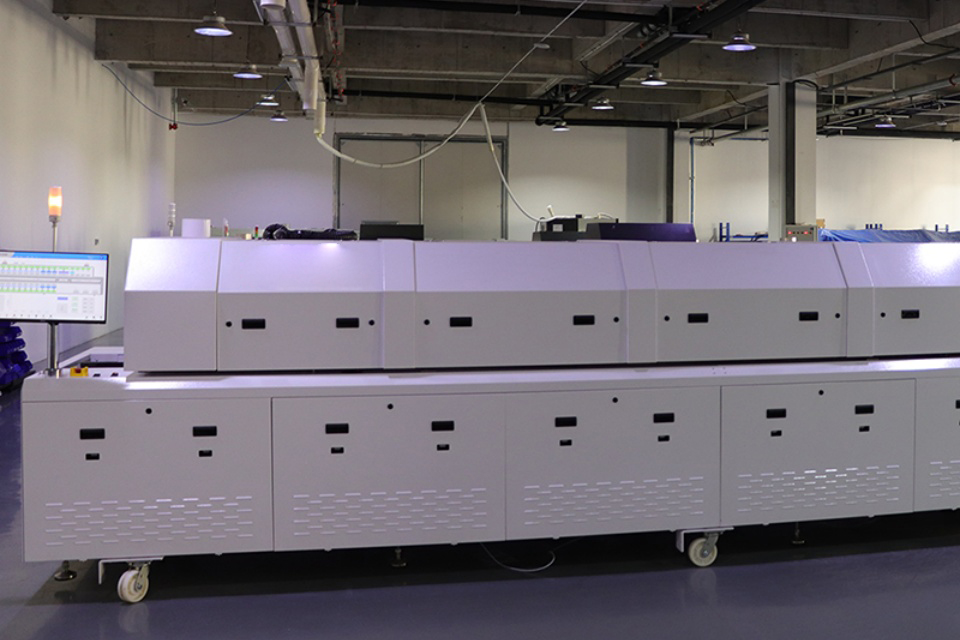
Oversized SMT handling comparison
| Handling factor | Standard components | Oversized components | What to verify |
|---|---|---|---|
| Pickup stability | Predictable | Affected by weight and shape | Nozzle fit, vacuum, pickup repeatability |
| Vision alignment | Standard libraries often work | Irregular edges may confuse cameras | Lighting, recognition recipe, test images |
| Feeding | Tape-and-reel common | Tray or custom fixtures may be needed | Feeder compatibility and changeover time |
| Placement speed | High-speed possible | Speed may need derating | Real CPH with actual parts |
| Board support | Basic support may work | Flex control becomes important | Support pins, tooling, vacuum support |
| Maintenance | Lower stress | More nozzle and feeder wear | Spare parts and inspection schedule |
Notice what the table does not say: buy the fastest machine.
Speed sells. Stability ships.
When a standard SMT pick and place machine is enough
A standard SMT pick and place machine may be enough when oversized parts are light, consistently shaped, easy to feed, and compatible with available nozzles.
That is a narrow lane.
A 30 mm connector with a flat top may run well. A 30 mm connector with an uneven surface, loose packaging tolerance, and off-center weight may become a daily headache. Geometry matters more than the category name on the BOM.
For early-stage builds, prototype and small-batch SMT lines are useful because they expose handling problems before volume production makes them expensive.
When custom handling becomes necessary
Custom large parts assembly automation becomes necessary when standard vacuum pickup, feeder presentation, or placement control cannot deliver repeatable results.
Custom does not always mean complicated.
Sometimes it is a better nozzle. Sometimes it is a tray fixture. Sometimes it is a slower head movement for one component. Sometimes it is a different placement sequence. And sometimes the right answer is a full turnkey SMT line solution instead of patching together disconnected equipment.
The key question is not, “Can this machine place large components?”
The real question is, “Can this machine place my large components, on my boards, at my volume, with acceptable yield?”
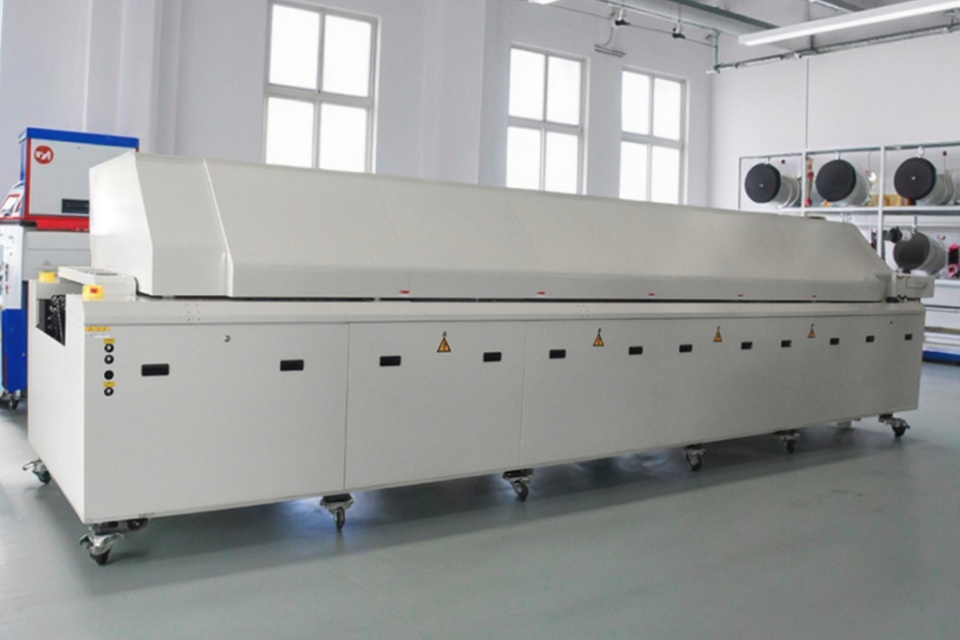
Nozzles, force, and board support
Nozzles are not minor accessories. They decide whether oversized part pick and place works.
A good nozzle must hold the part flat, centered, and stable through pickup, travel, vision correction, and release. Large parts may need bigger contact areas, softer materials, or multi-port vacuum.
Placement force matters too. Heavy component placement can flex the PCB, distort solder paste, or leave the part sitting too high. Thin boards, routed panels, and boards with cutouts are especially vulnerable.
For larger components, I want to see controlled Z-height, verified placement force, strong board support, first-article inspection, and a practical spare parts and accessories plan.
FAQ
What is large component handling in a pick and place machine?
Large component handling in a pick and place machine is the controlled feeding, pickup, vision alignment, movement, and placement of oversized or heavy SMT parts that exceed normal chip-package assumptions. It focuses on nozzle fit, feeder compatibility, board support, and placement force.
How do you handle oversized components in pick and place automation?
Oversized components are handled by matching the part to the correct feeder, nozzle, vacuum level, vision recipe, movement speed, and PCB support method. The process should be tested with real components before full production.
What is the biggest mistake when placing heavy SMT components?
The biggest mistake is assuming that component size alone proves machine compatibility. Heavy SMT components can still fail because of poor vacuum grip, unstable feeding, weak board support, or incorrect placement force.
Are custom nozzles necessary for large parts assembly automation?
Custom nozzles are necessary when standard nozzles cannot hold the component flat, centered, and stable during pickup, movement, vision correction, and placement. Irregular, heavy, or fragile parts often require special nozzle geometry.
Is a high-speed SMT pick and place machine good for oversized parts?
A high-speed SMT pick and place machine is good for oversized parts only if its head, nozzle system, feeder options, vision system, and board support are designed for them. Controlled handling matters more than peak speed.
Conclusion
If oversized parts are part of your SMT roadmap, do not spec the line around the easy components. Spec it around the part most likely to embarrass the process.
Start with the machine envelope, then verify pickup stability, nozzle fit, feeder logic, vision recognition, placement force, and board support using real parts. For serious projects, review the full SMT solution options or send board and BOM details through the contact page before choosing a configuration.