Specs lie quietly.
A Pick and Place Machine datasheet may show 115,000 CPH, ±25 μm accuracy, 0201 handling, dual-lane transfer, 128 feeder slots, IPC-9850 references, and a polished product photo, yet none of that tells you whether your actual PCB line will ship more usable boards per shift. So why do buyers still quote headline CPH as if it were throughput?
I have a blunt view: the pick and place machine market rewards people who read footnotes. Not headlines. Not sales decks. Footnotes.
That is where the truth hides: “under optimum conditions,” “chip component,” “Cpk ≥ 1.0,” “single-lane,” “high-production mode,” “depending on usage conditions,” “standard specification.” Those phrases are not decoration. They are warnings.
IPC itself created IPC-9850A because machine suppliers historically used different methods to report speed and accuracy, making fair machine comparisons difficult; the standard defines methods for reporting placement accuracy as a relationship to placement speed across SMT component sizes and configurations. (shop.electronics.org)
That matters because 2024 was not a gentle year for electronics manufacturing. IPC’s July 2024 electronics manufacturing supply-chain report said industry demand weakened for the fourth consecutive month, while labor and material cost indices stayed in expansion territory, meaning many factories were still under cost pressure even as orders softened. (iconnect007.com)
Automation pressure is not theoretical either. The International Federation of Robotics’ 2024 report recorded 4,281,585 robots operating in factories worldwide, up 10%, with more than half a million annual installations for the third straight year. (IFR Federación Internacional de Robótica) Reuters also reported in November 2024 that China had overtaken Germany in industrial robot density, with China reaching 470 robots per 10,000 workers versus Germany’s 429, based on IFR data. (Reuters)
That is the world your SMT placement machine is competing in. Not a brochure world. A cost-per-board world.
If you are comparing equipment for a prototype lab, start with líneas SMT para prototipos y lotes pequeños. If you are building phone chargers, LED boards, automotive ECUs, power modules, or consumer electronics at scale, you need to look harder at líneas de producción en serie de alta velocidad. The machine class changes. The risk changes. The math changes.
What CPH Really Means In A Pick And Place Machine
CPH means components per hour, but the dirty secret is that “components” are not equal.
A 0402 resistor is not a BGA. A simple LED board is not a dense 6-layer IoT module. A tray-fed connector is not an 8 mm tape passive. A component that needs vision centering, theta correction, height sensing, and slow Z-axis placement will not behave like the clean little chip used in a speed test.
That is why “What is CPH in pick and place machine?” is not a beginner question. It is the first question serious buyers ask.
Yamaha’s official YRM20 specification, for example, lists 115,000 CPH under optimum conditions with a super high-speed rotary RM head, while also showing different CPH values depending on head type and beam configuration; the same page lists high-accuracy mode at ±0.025 mm or ±0.035 mm Cpk ≥ 1.0 depending on configuration. (Sitio mundial de Yamaha Motor) Panasonic’s NPM-WX specification lists placement head maximum speeds of 47,000 CPH and 35,000 CPH, with placement accuracy values of ±25 μm and ±15 μm, again with conditions and configuration details attached. (Panasonic Connect)
See the pattern?
Speed is conditional. Accuracy is conditional. Capacity is conditional.
The hard truth: if a supplier gives you one CPH number and no board profile, no component mix, no feeder map, no lane mode, no head configuration, no IPC-9850 basis, and no expected utilization percentage, you do not have a production estimate. You have advertising.
For buyers comparing máquinas pick and place, I’d ask for three numbers:
The advertised maximum CPH.
The IPC-style or tested CPH.
The expected real CPH on your board, with your BOM, your feeder loading, your inspection rules, and your operators.
If the third number is missing, the first two are theatre.
Accuracy: The Number That Looks Small And Costs Big
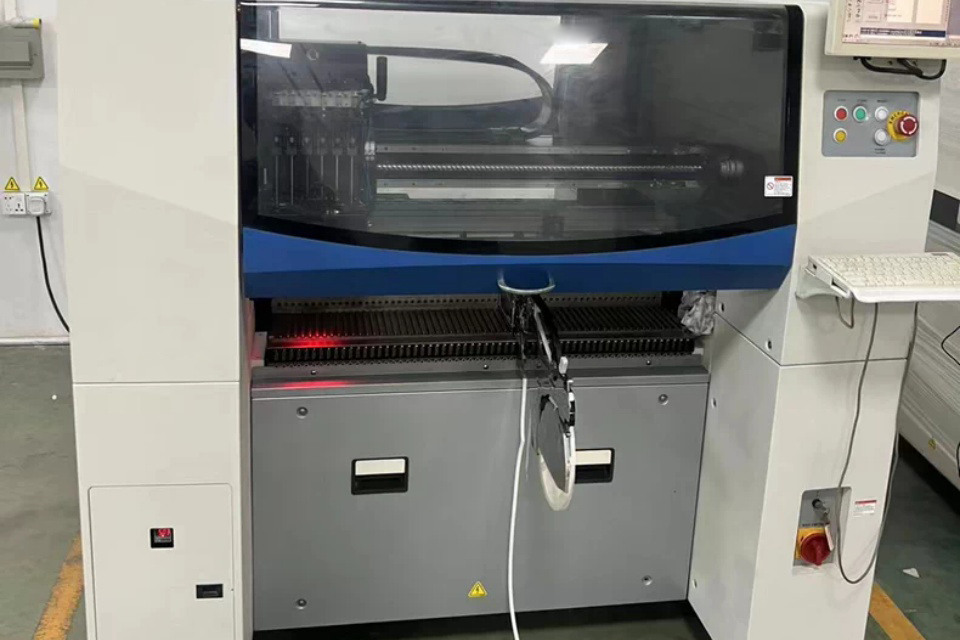
SMT pick and place machine accuracy is usually expressed in microns or millimeters: ±25 μm, ±35 μm, ±50 μm. It looks clean. It is not.
Accuracy depends on vision calibration, nozzle wear, feeder repeatability, board support, thermal drift, component geometry, PCB fiducials, solder paste quality, and the placement force profile. A machine can be mechanically capable and still produce misalignment if the upstream process is sloppy.
This is where I get opinionated: buyers overpay for theoretical speed and under-budget for process discipline.
A ±25 μm chip mounter running bad feeders, dirty nozzles, warped boards, and poor stencil printing is not a precision system. It is an expensive mistake with a touchscreen.
That is why SMT placement machine specifications should be read as a system document, not a machine document. The mounter depends on the printer. The reflow oven depends on the paste deposit. AOI depends on placement consistency. The feeder cart and nozzle set affect uptime. The line is the product.
For full-line planning, look at soluciones de línea SMT llave en mano rather than treating the placer as a standalone purchase. And yes, I know that sounds like vendor language. But in this case, it is true.
Speed: The Trap Between Motion Speed And Shipment Speed
Pick and place machine speed is not the same as production speed.
Motion speed is how fast the machine can pick, align, travel, and place. Production speed is how many good boards leave the line per hour after changeover, feeder replenishment, nozzle cleaning, bad-pick recovery, inspection feedback, reflow constraints, and operator intervention.
That gap is where ROI dies.
A high-speed machine can lose to a slower machine if the slower machine has better changeover, smarter feeder setup, stronger local support, cleaner programming, better spare parts availability, and fewer stoppages. I have zero patience for “fast” equipment that turns every product change into a maintenance ritual.
For high-mix production, I would rather see fast feeder exchange, offline programming, barcode traceability, stable vision, and reliable nozzle libraries than a heroic CPH number no one reaches after week two.
For volume production, I care about balance: printer cycle time, placement split, reflow oven length, AOI bottlenecks, loader/unloader speed, and whether the mounter is starving or blocking. A pick and place machine cannot outrun a bad line design.
If you need support after installation, not just a crate and a payment request, read the vendor’s formación y asistencia posventa terms before you sign anything.
The Specification Table Buyers Should Actually Build
| Especificación | What Sales Sheets Say | What You Should Ask | Why It Matters |
|---|---|---|---|
| CPH | 35,000 to 115,000+ CPH | Is that IPC-9850, optimum chip rate, or real BOM throughput? | Headline CPH rarely equals usable line output. |
| Precisión | ±15 μm to ±35 μm | At what Cpk, component type, speed mode, and calibration state? | Fine-pitch ICs, BGAs, 0201/03015 parts, and medical/automotive boards punish weak placement control. |
| Gama de componentes | 0201 to large odd-form parts | Does one head cover the full range, or are head/nozzle changes needed? | Flexibility affects downtime and changeover pain. |
| Alimentadores | 80, 128, 136+ positions | How many usable 8 mm feeders after trays, sticks, and special parts? | Feeder count is often overstated for real BOMs. |
| PCB size | 50 × 50 mm to 750 × 610 mm or more | Is that single lane, dual lane, batch mode, or option-dependent? | Board size limits can kill product plans later. |
| Changeover | “Fast” | How many minutes from Product A good board to Product B good board? | High-mix factories live or die by changeover. |
| Ayuda | “Global service” | Where are spare parts, engineers, and escalation contacts located? | Downtime cost often exceeds the price difference between machines. |
How To Read Pick And Place Machine Specifications Without Getting Played
Start with the BOM.
Not the machine. The BOM.
Count placement points by component family: passives, ICs, connectors, shields, LEDs, BGAs, odd-form parts. Then identify the slow parts. Your real throughput is usually controlled by the annoying minority: tray parts, vision-heavy packages, polarity-sensitive LEDs, tall connectors, warped boards, and components that force slower placement force.
Then map feeders.
A machine that claims 128 feeder slots may not give you 128 useful feeders if you need tray units, stick feeders, wider tape, duplicate feeders for high-run components, or offline setup carts. This is why Alimentador SMT compatibility is not a side issue. It is production architecture.
Next, compare head strategy.
Some machines are optimized for high-speed chip placement. Others are better for mixed components. Some offer modular head choices. Some demand more changeover pain than the brochure admits.
Finally, ask for proof.
Run your Gerber, centroid file, BOM, panel size, and target shift pattern through a real simulation. Get expected CPH by board, not machine. Ask for cycle-time breakdown. Ask where the bottleneck lands. If the supplier refuses, that tells you more than the datasheet.
Yamaha, Panasonic, Fuji, Hanwha, Juki: Brand Names Are Not A Strategy
Brand matters. But brand is not a process.
A Yamaha pick and place machine may be a smart fit for certain high-efficiency modular lines. Máquinas pick and place Panasonic often show strong placement accuracy and component flexibility. Máquinas Fuji pick and place are widely respected for modular production concepts. Hanwha pick and place machines y Máquinas Juki pick and place can make sense depending on product mix, price band, service access, and existing feeder ecosystem.
But the wrong machine from a good brand is still wrong.
I would rather buy a properly configured mid-speed machine with verified support than a glamorous high-speed platform that nobody in the plant can maintain. That is not conservative. That is survival.
The Buyer’s Red-Flag List
If a supplier says “actual speed depends on your product” but will not calculate your product, walk carefully.
If they quote CPH without component assumptions, push back.
If they avoid Cpk, placement repeatability, and IPC-9850, push harder.
If they treat nozzles, feeders, grease, calibration, software, and spare parts as minor extras, assume the ownership cost is being hidden.
And if the machine price looks suspiciously good, check the after-sales path. The cheapest machine can become the most expensive asset in the room when a $40 nozzle, a feeder calibration issue, or a vision camera fault stops a $20,000-per-day line.
For service expectations, read the promesa de servicio y política de garantía before procurement writes the purchase order.
Preguntas frecuentes
What is CPH in a pick and place machine?
CPH in a pick and place machine means components per hour, a throughput metric estimating how many electronic components the SMT placement machine can mount onto PCB pads in one hour under specified conditions, usually depending on component type, head configuration, feeder setup, board size, and test method. In real production, CPH should be derated against your BOM and panel flow.
How important is SMT pick and place machine accuracy?
SMT pick and place machine accuracy is the machine’s ability to place components within a defined positional tolerance, usually measured in microns and often tied to Cpk process capability, component package type, speed mode, calibration condition, and board handling stability. It matters most for 0201, 03015, fine-pitch IC, BGA, CSP, automotive, medical, and high-density PCB assemblies.
How do I read pick and place machine specifications correctly?
To read pick and place machine specifications correctly, separate advertised maximum values from tested production values by checking CPH conditions, IPC-9850 references, placement accuracy, Cpk level, feeder count, PCB size limits, component range, lane configuration, nozzle compatibility, and changeover assumptions. Then compare those figures against your actual BOM, panel design, shift schedule, and support plan.
Is higher pick and place machine speed always better?
Higher pick and place machine speed is not always better because real SMT output depends on line balance, component mix, feeder replenishment, printer cycle time, reflow capacity, AOI feedback, changeover time, operator skill, and downtime recovery. A slower but better-supported machine can outperform a faster machine when product mix is complex or batches are small.
What specifications matter most when buying a chip mounter?
The most important chip mounter specifications are real-world CPH, placement accuracy, supported component size range, feeder capacity, nozzle compatibility, PCB size limits, software workflow, changeover time, service availability, spare-parts supply, and integration with printers, reflow ovens, AOI/SPI, conveyors, and factory traceability systems. The best purchase decision is usually line-based, not machine-based.
Final Take
A Pick and Place Machine is not just a speed number. It is a promise about repeatability, uptime, service, software, feeders, nozzles, process control, and how honestly the supplier reports performance.
So read the CPH. Read the accuracy. Read the speed. Then read the conditions twice.
For a practical machine shortlist, start with the full pick and place machine product range, compare it against your BOM and target capacity, download the catalog resources, and contact the team through the SMT equipment inquiry page with your board size, BOM, placement count, and target boards per hour.