Large machines create large blind zones. That is not a design flaw in one brand or one machine class; it is a structural reality of steel frames, guarded work areas, long conveyors, rotating assemblies, enclosed process sections, and operator cabins that cannot show every hazard at once.
A Multi-Camera System gives operators, technicians, and production teams a wider, more useful visual field. In heavy equipment, that means fewer blind decisions around people, vehicles, and obstacles. In SMT and electronics manufacturing, it means better visibility over board handling, placement, inspection, alignment, feeder status, and process faults.
Why Blind Zones Still Beat Expensive Machines
Blind spots are not theoretical. They are measurable risk zones.
According to OSHA struck-by safety guidance, approximately 75% of struck-by fatalities involve heavy equipment such as trucks or cranes. NIOSH also maintains construction equipment visibility diagrams, updated in November 2024, showing blind areas around loaders, excavators, graders, scrapers, rollers, dozers, and other large machines.
That evidence matters because it removes the excuse. Visibility failure is not just an operator problem. It is an engineering, layout, camera-placement, maintenance, and procedure problem.
In factory environments, the same principle applies. A technician cannot inspect what the machine enclosure hides. A line supervisor cannot diagnose a board-transfer error after the event has passed. A pick-and-place machine cannot maintain yield if the vision system cannot reliably confirm fiducials, nozzles, components, or board position.
The hard truth is simple: if the machine cannot see the risk, the team is forced to guess.
What Multi-Camera Systems Actually Do
A Multi-Camera System is an integrated network of cameras, displays, controllers, cables, lighting, recording tools, and sometimes AI or machine vision software. Its purpose is not merely to add more screens. Its purpose is to improve decisions.
On large mobile machines, a multi-camera system for heavy equipment may include front, rear, side, overhead, and 360-degree stitched camera views. The goal is to help the operator identify workers, obstacles, edge hazards, traffic, and blind-side movement before a collision or near miss occurs.
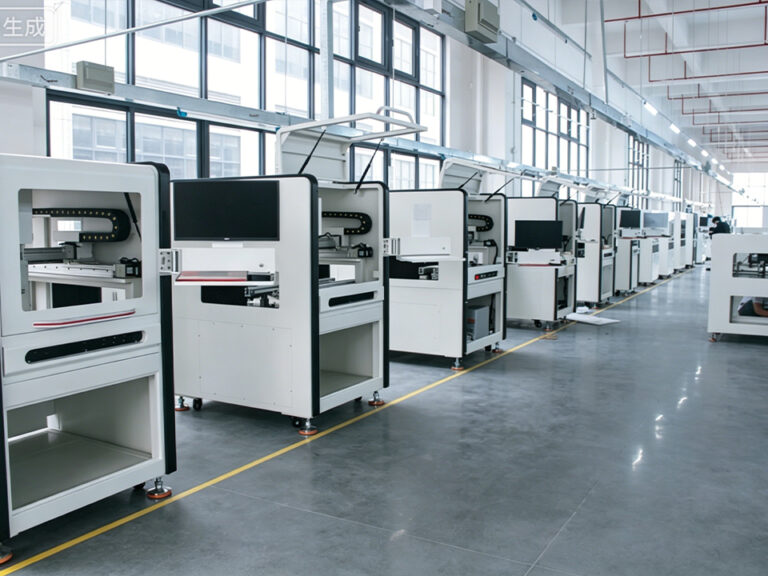
On industrial production equipment, an industrial camera monitoring system may track loading zones, access doors, conveyor transfers, robotic motion, feeder banks, inspection stations, and fault-prone sections of the line. For electronics manufacturers, this connects directly with SMT inspection systems, where visibility is not only about safety but also about yield protection.
A useful camera system answers a specific operational question.
Can the operator see the worker behind the counterweight? Can the technician verify the jam location without opening a guarded area? Can the line confirm whether the PCB shifted before placement? Can the AOI system detect solder defects consistently under real production lighting?
If the system cannot answer a decision-critical question, it is just video.
Heavy Equipment Lessons For Industrial Machines
Heavy equipment has already taught the visibility lesson the hard way. Large machines hide people. They hide corners. They hide ground-level movement. They hide objects close to the body of the machine, especially where operators assume mirrors or windows are enough.
The mining sector has moved toward more formal risk control. MSHA’s surface mobile equipment safety program rule requires covered mine operators to develop written safety programs for surface mobile equipment, including hazard and risk identification. The Federal Register final rule became effective in January 2024.
Factories should not ignore that trend. Even when a production site is not under the same regulation, customers, insurers, auditors, and internal EHS teams increasingly expect documented control of machine hazards.
This is where a 360-degree camera system for large machines can help, but only when used properly. A stitched overhead view can reduce blind-zone uncertainty, but it does not eliminate the need for traffic control, operator training, lens cleaning, lighting, alarms, maintenance checks, and clear procedures.
A 360-degree view is a layer. It is not a safety program.
Where SMT Lines Need Camera Coverage
SMT machines use cameras differently from loaders, cranes, or mining trucks. The machine may not need a rear-view display, but it absolutely needs visual certainty.
A modern pick-and-place machine may use upward-looking cameras for nozzle and component checks, downward-looking cameras for fiducial recognition and board alignment, and additional systems for barcode reading, feeder verification, or component presence detection. Buyers comparing pick-and-place machines should look beyond placement speed and ask how the machine verifies what it places.
AOI and SPI systems take this further. Brands such as Mirtec, Koh Young, Saki, Pemtron, Jutze, Parmi, and Meraif depend on camera angle, lighting geometry, calibration, software algorithms, and repeatable inspection conditions. A weak machine vision camera system can create false calls, missed defects, rework, and customer returns.
In high-volume electronics manufacturing, camera coverage becomes even more important because defects move quickly. A prototype technician may catch a problem manually. A mass-production SMT line usually cannot. That is why high-speed SMT production lines need visual control at placement, transfer, inspection, and process-review points.
Camera planning should also happen early in a full-line project. If the line layout is already frozen, adding useful visibility becomes harder and more expensive. For that reason, turnkey SMT line solutions should include camera strategy during layout, equipment selection, and process design.
System Comparison: Monitoring, Machine Vision, And 360-Degree Coverage
Not every camera system does the same job. Buyers often make expensive mistakes because they use “camera system,” “machine vision,” and “360-degree view” as if they mean the same thing.
They do not.
| System Type | Best Use Case | Common Mistake | Better Buying Question |
|---|---|---|---|
| Rear-view camera system | Reversing vehicles, forklifts, loaders, mobile carts | Treating one rear view as full coverage | Which blind zones remain after installation? |
| 360-degree camera system | Heavy machinery, yard equipment, large mobile platforms | Assuming stitched video removes all risk | Can the operator judge distance accurately near the machine body? |
| Industrial camera monitoring system | Factories, conveyors, access points, process zones | Installing cameras without workflow logic | What decision should this camera improve? |
| Machine vision camera system | SMT placement, AOI, SPI, barcode, fiducial, defect detection | Confusing video monitoring with measurement | What tolerance, lighting, and calibration are required? |
| AI-assisted multi-camera system | Pedestrian alerts, object detection, collision-risk monitoring | Over-trusting AI and ignoring false alarms | How are missed detections and alert fatigue managed? |
The best multi-camera systems for large machines are not the ones with the most cameras. They are the ones with the fewest blind decisions.
A four-camera system with intelligent placement can outperform an eight-camera system installed for appearance. A 1080p industrial camera with the correct lens, lighting, housing, and mounting position may outperform a higher-resolution camera staring into glare, vibration, flux haze, or dead space.
The same is true in SMT production. More vision hardware does not automatically mean better quality. The system must be calibrated, maintained, integrated, and tied to process decisions.
Buying Criteria That Actually Matter
A professional camera specification should start with the failure mode, not the camera count.
For heavy machinery, the buyer should map pedestrian paths, reversing zones, side blind spots, articulation points, loading areas, and high-risk interaction points. For factory equipment, the buyer should map board transfers, feeder access, maintenance doors, inspection points, jam areas, and operator decision points.
The strongest buying criteria usually include:
Camera placement and blind-zone coverage Lens angle and distance judgment Image latency and display response time Low-light and glare performance IP rating, vibration resistance, and housing durability Cable routing and connector reliability Cleaning access and maintenance intervals Machine integration and event recording Calibration requirements for machine vision Operator training and alert response procedures
For SMT operations, the camera system should also support process quality goals. That means fiducial recognition, nozzle inspection, component alignment, feeder verification, barcode traceability, AOI/SPI consistency, and fault-history review. A camera is not useful because it records images. It is useful because it helps protect yield, uptime, and repeatability.
Maintenance is often underestimated. A dirty lens can weaken the only view into a critical risk zone. A loose connector can create intermittent faults that look like software problems. A miscalibrated inspection camera can allow borderline defects to pass until customer returns expose the issue.
That is why camera planning belongs in the same conversation as maintenance and spare parts. Treat the camera system as production equipment, not an accessory.
FAQs
What are Multi-Camera Systems in large machines?
Multi-Camera Systems in large machines are integrated networks of multiple cameras, displays, controllers, and sometimes AI or machine vision software that expand visibility across blind zones, process points, and machine access areas. They help operators, technicians, and inspection systems see more of the machine before safety, quality, or uptime problems escalate.
In heavy equipment, these systems may cover rear, side, front, and 360-degree views. In SMT and industrial automation, they may support board alignment, component inspection, feeder monitoring, barcode reading, and process diagnostics.
How do multi-camera systems improve visibility in large machines?
Multi-camera systems improve visibility in large machines by capturing several machine angles at once and presenting them through displays, stitched views, alerts, recordings, or inspection software. This reduces hidden zones around heavy equipment and gives factory teams better visual access to process areas that operators cannot safely or consistently see directly.
The result is not just more video. The result is better decision support. Operators can detect nearby people or obstacles, while manufacturing teams can identify jams, placement errors, inspection issues, and abnormal machine behavior earlier.
What is the difference between an industrial camera monitoring system and a machine vision camera system?
An industrial camera monitoring system is mainly designed to help humans observe machines, work zones, access points, or production events, while a machine vision camera system is designed to measure, inspect, recognize, or verify objects through calibrated imaging and software. Monitoring improves awareness; machine vision supports automated quality decisions.
For example, a monitoring camera can show a conveyor jam. A machine vision system can detect whether a component is missing, rotated, misaligned, bridged, or outside tolerance.
Is a 360-degree camera system enough for heavy machinery?
A 360-degree camera system is not enough by itself for heavy machinery safety because it improves visibility but cannot replace blind-zone mapping, operator training, traffic control, maintenance, alarms, lighting, and written procedures. It should be treated as one layer in a larger risk-control system, not as a complete safety program.
The best results come when 360-degree coverage is combined with clear operating rules, clean camera housings, reliable displays, proximity awareness, and documented response procedures.
What should buyers check before choosing the best multi-camera system for large machines?
Buyers should check camera placement, blind-zone coverage, lens angle, image latency, IP rating, vibration resistance, low-light performance, display layout, AI detection limits, calibration needs, cleaning access, event recording, cable protection, and integration with the machine workflow. The system must solve a defined safety, inspection, or uptime problem.
For SMT equipment, buyers should also verify support for fiducial recognition, nozzle checks, component inspection, AOI/SPI compatibility, barcode traceability, feeder visibility, and after-sales calibration support.
Do SMT machines need Multi-Camera Systems?
SMT machines need Multi-Camera Systems when production quality depends on accurate visual confirmation, alignment, inspection, and traceability across multiple process points. Pick-and-place machines, AOI systems, SPI machines, conveyors, and PCB handling equipment often rely on cameras to protect yield and reduce missed defects.
In low-volume work, manual checks may catch some problems. In high-speed production, camera-based verification becomes much more important because defects can move downstream before humans notice them.
Conclusion
If you are choosing cameras for heavy machinery, SMT equipment, AOI/SPI inspection, or a full production line, start with the blind spots and failure modes instead of the camera count. Map the machine, define the risk, decide where visibility changes the decision, and then build the system around that evidence.
For practical equipment planning, speak with the team through SMT equipment consultation and bring your real machine problem, not just a camera wishlist.