I’ve heard the same line too many times in too many factories: “Labor’s killing us, so let’s buy automation,” which sounds decisive in a meeting, looks tidy in a capex deck, and usually ignores the uglier truth that margin erosion often starts in much smaller places—feeder prep, board changeovers, nozzle swaps, placement drift, line starvation, bad recipe control, and those quiet little stoppages nobody logs honestly because everybody’s already chasing the next lot. That’s the leak.
And, honestly, that’s why so many automation projects disappoint. Not because pick and place automation doesn’t work—it does—but because buyers keep expecting one machine to clean up a messy line, fix weak process discipline, and somehow erase years of bad floor habits with a PO and a commissioning date. It won’t. Not by itself.
The cost squeeze isn’t theoretical
But let’s start with the obvious part. The pressure is real.
The BLS productivity release from May 2024 reported that manufacturing unit labor costs rose 5.0% year over year in the first quarter of 2024, while manufacturing labor productivity rose 1.2%. The 2024 NIST report on the U.S. manufacturing economy added another uncomfortable number: labor productivity for manufacturing increased just 0.4% between Q2 2023 and Q2 2024. That’s not a healthy spread. It’s a margin squeeze wearing a necktie. (bls.gov)
Then zoom out. The International Federation of Robotics reported in September 2024 that 4,281,585 robots were operating in factories worldwide, with 541,302 new industrial robots installed in 2023, and 70% of those new deployments concentrated in Asia. Reuters, citing IFR data, noted that China reached a robot density of 470 robots per 10,000 workers in 2023, ahead of Germany’s 429. So, yes, the market has already voted. Pretty clearly.
I frankly believe a lot of executives still misunderstand what those numbers mean. They hear “automation” and think payroll reduction. I hear “automation” and think variance control—fewer human touches, tighter placement repeatability, less feeder chaos, fewer rework loops, less babysitting. That’s a different conversation. A smarter one.
Where the money actually leaks on an SMT line
Here’s the ugly truth: most factories don’t bleed profit because operators are lazy or because one machine spec is 12% slower on paper. They bleed because the line never quite settles—paste print goes marginal, feeder carts aren’t staged right, reels get swapped late, nozzles start acting up, AOI throws false calls, and the whole production floor gets dragged into this low-grade firefighting routine that feels normal only because it happens every day.
It gets expensive.
From my experience, the real cost stack in SMT is rarely just direct labor. It’s direct labor plus line interruption plus hidden rework plus quality escapes plus schedule slippage plus management pretending those are separate buckets when, in reality, they bounce off each other all shift long. That’s why reducing production costs with pick and place automation isn’t mainly about speed. It’s about friction.
And that friction has names insiders know well: feeder verification, reel change discipline, first-pass yield, OEE drift, nozzle life, NPI turbulence, placement offsets, recovery time after a hard stop. Outsiders hear jargon. Floor people hear margin.
Why a pick and place machine only works in the right system
Yet this is where buyers still get themselves into trouble. They compare machine against machine—Yamaha YSM20R versus Panasonic NPM-W2S versus Juki RS-1R versus Hanwha XM520—as if they’re buying an engine, when what they’re really buying is a piece of a living production system with upstream and downstream dependencies that can either protect the economics or quietly wreck them.
That’s why I never like “What’s your fastest model?” as the opening question. Wrong question. The better question is nastier: what happens to cost per good board after eight messy production hours, three reel changes, a nozzle issue, one program adjustment, and the usual operator handoff nobody put in the brochure?
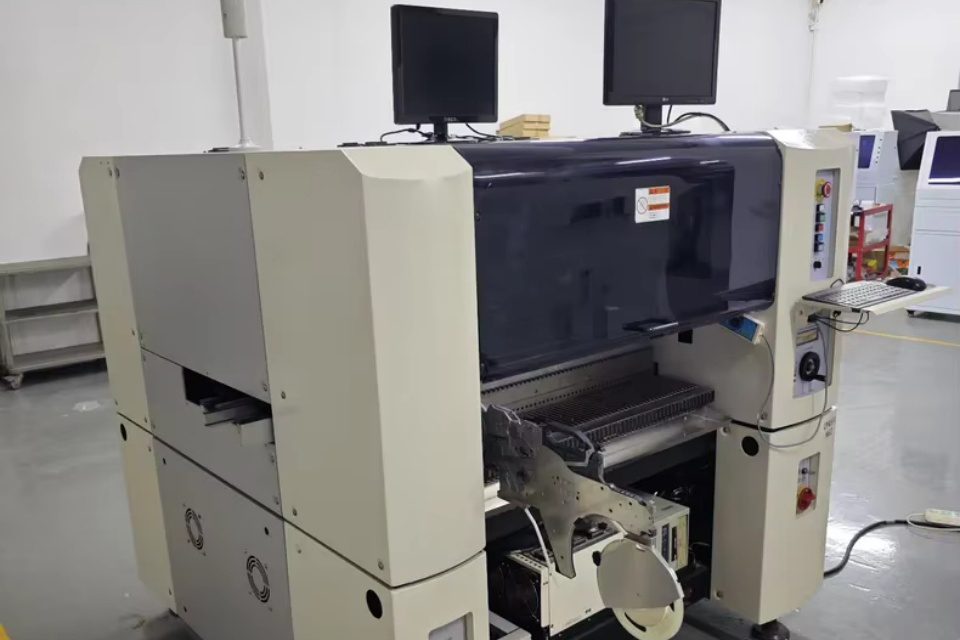
A pick and place machine doesn’t earn its keep in a vacuum. It earns its keep when the print process is stable enough, material control is disciplined enough, feeder setup is tight enough, and downtime response is fast enough that the machine can keep cadence instead of turning into a very expensive monument to bad line design.
Which is exactly why I’d rather talk about turnkey SMT line solutions earlier than most vendors do. Because, no, optimizing one asset in isolation isn’t the same thing as lowering factory cost. It just feels good in procurement meetings.
Where savings usually show up first
Usually, the first win isn’t dramatic. It’s operational.
A line that’s been drowning in touch labor and stop-start behavior can suddenly breathe once placement becomes more repeatable, manual handling drops, and setup discipline improves around the machine. Then the second-order savings start showing up—less rework, steadier takt, better planning confidence, fewer panic interventions, cleaner handoffs to inspection. That’s the stuff that doesn’t always make the sales pitch but makes the P&L look less stupid.
| Cost lever | Manual-heavy or poorly automated line | Well-matched pick and place automation | What management often misses |
|---|---|---|---|
| Direct labor | More operators per shift, more repetitive handling | Fewer manual touches and less operator dependency | Headcount reduction is only part of the gain |
| Changeover time | Feeder prep and line resets consume margin | Better setup discipline and faster recovery between jobs | High-mix lines live or die on changeovers |
| Defect cost | Misplacements, rework, solder issues, hidden scrap | More consistent placement and process repeatability | Rework cost is usually undercounted |
| Throughput stability | Stops ripple across the whole line | Better uptime when machine, feeders, and support are aligned | Downtime destroys theoretical speed claims |
| Planning flexibility | Rush jobs cause chaos | Better scheduling when recipes and setup control are mature | Software and process control matter as much as hardware |
I’ve seen managers stare at that kind of table and still obsess over labor first. Fair enough—labor is visible. Rework drag usually isn’t. Neither is the true cost of a shaky changeover culture. Or the cost of tiny interruptions that never become “official downtime” but still murder throughput by the end of the week.
So when someone asks me about labor cost reduction in manufacturing, I usually say yes, absolutely, but don’t stop there. If your only win is labor, you probably underbought the line—or misunderstood the problem.
The best setup depends on your production mix, not your ego
However, this is where a lot of buyers get weirdly emotional. They want the “best” machine. The prestige machine. The one with the cleanest demo and the biggest spec sheet chest-thumping. I get it. But that mindset can be expensive.
If you’re running constant NPI churn, short lots, awkward product families, and frequent feeder changes, I’d be looking hard at prototype and small-batch SMT lines. In that world, flexibility is money. Setup discipline is money. Program agility is money. A rigid high-output line that hates changeovers can chew through margin faster than a slower but better-matched setup.
If you’re running stable demand, long schedules, fewer BOM surprises, and a cleaner planning environment, then high-speed mass production lines start making far more sense. Different animal. Different math. Same mistake if you buy the wrong one.
And that’s the thing I’d underline if I were being blunt in a boardroom: “best pick and place automation for manufacturing” is a meaningless phrase until somebody pins it to actual board complexity, shift pattern, feeder strategy, line balancing, maintenance maturity, and demand volatility. Otherwise it’s just trade-show language.
What kills payback faster than people admit
But the hardware usually isn’t the first thing that fails. The process does.
Weak setup verification. Sloppy spare-part planning. No real discipline around feeder prep. Operators doing tribal-knowledge workarounds. Maintenance teams stuck reacting instead of preventing. Those things can turn a good automation purchase into an irritating payback story in six months flat.
This is why I put more weight on service than a lot of buyers do. I’d rather take slightly less glamorous equipment with serious training and after-sales support than buy a prettier line that becomes a paperweight every time a weird fault shows up. That’s not me being conservative. That’s me having watched too many “great deals” become downtime.
And don’t just swallow the polished pitch. Read actual customer cases in SMT production. Not because every case study is pure truth—it isn’t—but because even the omissions are useful. What they brag about tells you one thing. What they avoid tells you another.
From my experience, the most reliable payback cases have one thing in common: they know their losses before they automate. Changeover minutes. First-pass yield. Placement-related rework. Intervention rate. Cause-coded downtime. If those numbers are fuzzy, the ROI model is basically fan fiction.
FAQs
How to reduce production costs with pick and place automation?
Reducing production costs with pick and place automation means lowering the fully loaded cost per good board by using automated placement equipment to cut manual handling, setup loss, defect-driven rework, and line stoppages across SMT production rather than focusing only on labor replacement or theoretical speed.
What matters after that is measurement. If you’re not tracking changeover drag, feeder-related delays, first-pass yield, and intervention frequency before and after install, you’re guessing—and factories that guess usually overstate the win.
Can a pick and place machine reduce labor cost in manufacturing?
A pick and place machine reduces labor cost in manufacturing by shifting repetitive component placement and board-handling work away from manual operators, which lowers touch time per unit, reduces reliance on scarce labor, and allows a smaller team to supervise more stable output.
Yes, but. Labor isn’t the whole prize. I’ve seen bigger savings come from lower rework, fewer operator-induced placement mistakes, and less floor chaos during schedule changes.
What is the best pick and place automation for manufacturing?
The best pick and place automation for manufacturing is the line configuration that matches actual board complexity, product mix, feeder requirements, maintenance capability, and output targets while delivering the lowest sustainable cost per good unit over time instead of the highest quoted placement rate.
I’d say it even more bluntly: the best system is the one that still makes money when the schedule gets annoying. That’s the test. Not the demo.
Are robotic pick and place systems worth it for low-volume production?
Robotic pick and place systems are worth it for low-volume production when product complexity, labor cost, setup discipline, and quality requirements are strong enough that automation reduces handling cost, variation, and scheduling friction despite smaller batch sizes and more frequent changeovers.
Sometimes yes. Sometimes absolutely not. Low volume by itself doesn’t decide it—process stability does.
Is reducing production costs with pick and place automation mainly about speed?
Reducing production costs with pick and place automation is mainly about improving repeatable economics across labor, quality, changeovers, and uptime because raw speed only helps when the rest of the SMT line can feed, inspect, and recover at the same pace without creating new waste.
I don’t trust speed claims in isolation. Too many veteran operators don’t, either. Fast on paper and profitable on the floor are not the same sentence.
If you’re serious about cutting cost—not just making the line look more modern—start with the losses that are already sitting in front of you, then map the automation around that reality. And when you’re ready to have the uncomfortable version of that conversation, use the contact page and bring real numbers, not brochure optimism.