I’ve seen this movie before. A factory spends serious money on dashboards, cloud pipes, glossy “AI” middleware, and a stack of vendor promises tall enough to block the line supervisor’s view of the actual problem—meanwhile the head is still chasing offsets, feeders are still burping parts, and the placement loop is still losing time where it hurts most: right at the machine.
And that’s the part people soften too much. I won’t. In pick and place, the argument isn’t about whether data has value. Of course it does. The argument is about where the decision gets made when a fiducial read looks wrong, when nozzle vacuum drops a hair, when a reel advances badly, when a board creeps just enough to turn “acceptable” into rework. That’s where edge computing stops sounding fashionable and starts sounding necessary.
Why Edge Computing Fits Pick And Place Better Than Cloud-First Architectures
But let’s not pretend every compute model belongs in the same place.
A pick and place machine runs inside a brutally tight loop—detect, verify, compensate, place, move again—and when somebody inserts avoidable delay into that chain because they’re obsessed with centralizing everything, the damage rarely arrives as one spectacular failure; it leaks out as tiny cycle penalties, avoidable escapes, nuisance stops, placement drift, and the kind of line instability operators feel immediately even when management can’t yet see it in the weekly KPI sheet.
That’s the real issue.
I frankly believe a lot of teams still treat edge computing in pick and place like a side dish to cloud infrastructure, when it’s actually the thing that protects the machine from becoming dependent on network distance for decisions that should’ve been settled locally in the first place. Put plainly: if the head is already moving, the answer can’t be stuck somewhere upstream waiting for approval.
And yes, the market signals are there. Reuters’ 2024 reporting on AI deployment in manufacturing pointed out an awkward gap: spending was rising, but implementation rates were still lagging, and manufacturers kept citing accuracy concerns. I’m not surprised. Not even a little. Plenty of plants are buying intelligence faster than they’re learning where intelligence actually belongs.
Where Local Processing Delivers the Most Value on the Line
Start with vision.
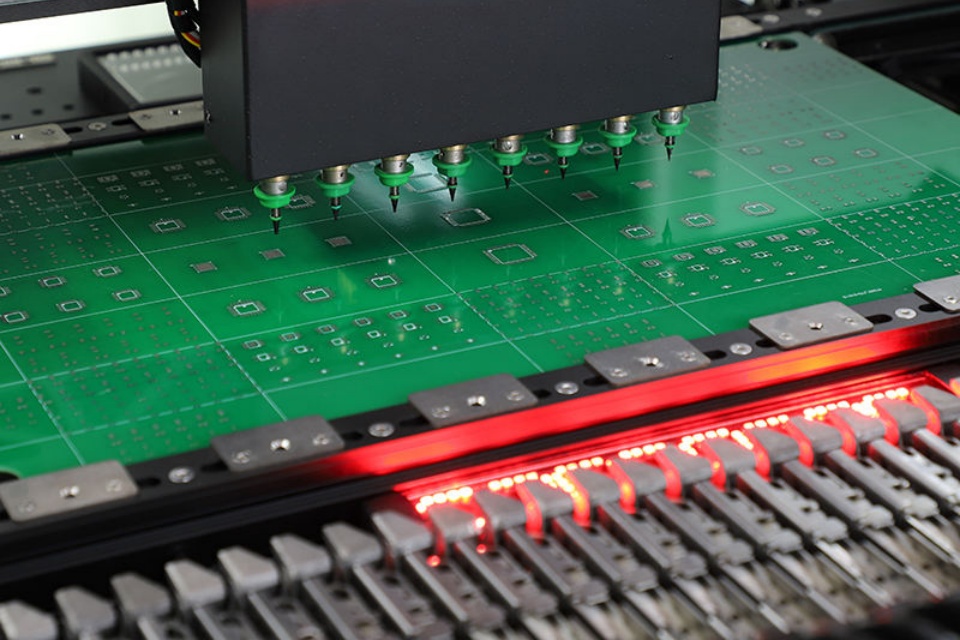
Not the fluffy “computer vision strategy” slide. I mean the real stuff—fiducial lock, board offset, component orientation, pickup confirmation, nozzle contamination patterns, feeder hesitation, micro-stops that don’t look dramatic unless you live beside the machine for a shift. That’s where local processing for pick and place systems kiếm được tiền.
From my experience, the best local decisions are boring. Boring is good. Boring means the machine saw something odd, interpreted it on the spot, corrected fast, and kept the build from snowballing into a defect cluster. Nobody throws a party for that. They should.
Then there’s feeder behavior, which outsiders underestimate constantly. Feeders don’t usually fail in some cinematic way. They get twitchy. Slight misfeeds. Inconsistent advance. Small pickup instability. The kind of junk that ruins confidence because the line still “runs,” technically, while quality starts getting salted away in places finance won’t notice until later. Edge logic can spot that pattern faster than a remote layer ever should.
And if that local intelligence is tied back into chất lượng quy trình and integrated Hệ thống kiểm tra SMT, now we’re talking about something serious: a line that can learn while it’s working, not just produce a postmortem after the damage is already baked in.
That’s the difference.
The Operational Case for Edge AI in High-Speed Placement
Here’s the ugly truth: a lot of “AI for factories” talk is recycled automation copy with a shinier wrapper. I’m not against AI. I’m against vague AI.
But edge AI for pick and place is different when it’s deployed for a narrow, machine-adjacent job and expected to produce an actual operational effect—classify a visual anomaly, interpret a pose issue, flag an emerging nozzle problem, sort signal noise from an actual event, prioritize what deserves a stop and what deserves a correction. That’s real. That’s useful. That’s not brochure theater.
And speed alone won’t save you.
Deloitte’s 2024 manufacturing outlook showed just how confident manufacturers have become about smart-factory investment and digital systems. Fine. Investment is easy. Architecture is harder. You can spend millions and still build a line that waits too long to react because nobody had the nerve to admit the control stack was in the wrong place.
I keep coming back to the same rule: if the decision affects the next motion cycle, keep it local. If it affects next quarter’s planning, send it upstairs. That sounds obvious, yet factories violate it every day.
And in real-time processing in robotic pick and place, “real-time” isn’t a marketing adjective. It means the placement loop still behaves when noise hits the sensors, when camera data spikes, when recipe complexity goes up, when product mix gets uglier, when the line is running hot and no one has time for theoretical elegance.
What the Evidence Actually Suggests
Yet I don’t like leaning on opinions alone, even when they happen to be right.
Năm 2024 State of Edge AI report put manufacturing among the largest revenue segments for edge AI and tied that growth to reduced latency, real-time decision-making, defect detection, cost control, and tighter data handling. None of that feels surprising if you’ve spent time around an SMT line. Distance costs money. It just doesn’t always invoice you immediately.
There’s also the more interesting academic angle. A 2024 RWTH Aachen paper on an edge computing framework for robotic assembly described a successful pilot implementation in a pick-and-place context, with the edge layer acting as the central intelligence point for sensor processing and decision support. That paper gets into the stuff vendors often skip—jitter, packet delay, communications reliability, system layering. Good. It should. Those details decide whether the architecture behaves under pressure or just demos well in a lab.
That’s why I trust systems evidence more than slogans.
Because once you’re deep in production, nobody cares whether the presentation said “Industry 4.0” twelve times. They care whether the machine corrected the error before the next board entered the working zone.
What Buyers Should Compare Before They Compare Speed
I still see buyers fixate on CPH as if that’s the whole story. It isn’t.
A machine can look fast on paper and still feel slow in a messy factory because actual throughput depends on recovery behavior, exception handling, feeder stability, vision confidence, inspection feedback, and how gracefully the line absorbs weirdness. Weirdness is normal, by the way. Low-volume/high-mix shops know this. Prototype teams know it. Anyone running a line with real product churn knows it.
So before somebody obsesses over datasheet bragging rights, ask tougher questions. How does the system behave when the WAN drops? Where does vision inference run? Can AOI feedback influence placement logic without waiting on some remote orchestration layer? What’s the rollback path if a model update turns flaky? Does the vendor understand jitter budgets—or do they just know how to say “AI-ready”?
Here’s the practical comparison that matters:
| Decision area | Cloud-first answer | Edge-enabled answer | Tại sao điều đó quan trọng |
|---|---|---|---|
| Vision correction | Data sent for centralized analysis | Correction handled locally | Reduces reaction delay during placement |
| Feeder anomaly detection | Logged and reviewed later | Flagged in real time | Prevents repeat pickup or feed faults |
| AOI feedback loop | Post-process review | Immediate local adjustment path | Supports closed-loop quality |
| Network interruption | Performance may degrade or stall | Line continues core functions locally | Protects uptime |
| Model updates | Centralized but slower to validate on-machine | Local deployment with controlled rollback | Safer operational learning |
That table looks simple. It isn’t. It’s basically the operating difference between a line that reacts and a line that reports.
And if you’re planning Dây chuyền sản xuất hàng loạt tốc độ cao, more flexible Dây chuyền sản xuất SMT hỗn hợp, or complete Giải pháp dây chuyền sản xuất SMT trọn gói, those questions stop being “nice to have.” They become budget questions, uptime questions, customer-return questions.
The Best Architecture Is Usually Hybrid, Not Ideological
Now for the part people like to oversimplify.
I don’t buy the all-cloud sermon. Never did. But I also don’t buy the fantasy that everything should live on the edge forever, cut off from centralized governance, historical analytics, or cross-site learning. That’s not smart manufacturing. That’s just another form of rigidity.
The best answer is usually hybrid. Messier. More adult.
Local infrastructure should own the time-sensitive work: vision inference, event handling, line-state monitoring, micro-corrections, exception prioritization. Central systems should own the slower, broader, and more political work: fleet analytics, compliance trails, recipe libraries, model lifecycle control, benchmarking across plants, long-horizon optimization. That’s what smart manufacturing edge computing looks like when it’s designed by people who’ve actually lived through line instability.
So when someone asks me about the best edge computing solutions for pick and place, I don’t start with brands or buzzwords. I start with failure modes. What breaks first? How fast can the system degrade gracefully? Can it keep placing safely if the network stutters? Can engineers roll back a bad deployment without turning the shift into a fire drill? If the vendor can’t answer those questions clearly—without hand-waving—I’d keep my wallet closed.
That’s my bias. Earned the hard way.
Câu hỏi thường gặp
What is edge computing in pick and place?
Edge computing in pick and place is the use of local computing resources near the machine or production line to process vision, sensor, and control data in real time, so the system can make placement-related decisions with minimal delay and reduced dependence on remote servers. In plain terms, the machine thinks closer to where the mistake happens. That’s why the response is faster, and usually safer.
How does edge computing improve pick and place accuracy?
Edge computing improves pick and place accuracy by processing inspection, alignment, and machine-state data close to the equipment, which shortens reaction time and allows faster compensation for drift, misfeeds, pickup errors, and board-position deviations before those problems spread across a production run. It catches trouble earlier. Usually earlier than a centralized stack ever could.
What is edge AI for pick and place?
Edge AI for pick and place is the deployment of machine-learning models on local industrial hardware to interpret images, sensor signals, and machine conditions in real time, allowing immediate decisions on classification, correction, stoppage, or escalation without relying on a cloud round trip. Done right, it handles one tight problem well. Done badly, it becomes expensive decoration.
Is cloud computing still useful in SMT environments?
Cloud computing remains useful in SMT because it supports centralized analytics, fleet management, traceability, recipe storage, long-term model training, and cross-site visibility, all of which matter for strategic optimization even if they are poorly suited to live machine reflexes. So yes, cloud still matters. Just not inside every millisecond-sensitive decision loop.
What are the best edge computing solutions for pick and place?
The best edge computing solutions for pick and place combine local vision processing, machine-state analysis, fast event handling, inspection feedback integration, and controlled coordination with centralized systems, so manufacturers get both rapid response on the line and stable governance across products, plants, and updates. I’d look for resilience first. Feature lists can lie; recovery behavior usually doesn’t.
If your team is reviewing a new line, patching an older one, or trying to stop defects from hiding behind polished software language, begin with the decision path—not the dashboard. Then review the available máy lắp ráp hoặc Liên hệ với đội ngũ to talk through how local compute, inspection feedback, and line architecture should actually be set up for your production reality.