It looks easy. You roll in a new mounter, bolt on a conveyor, wire SMEMA, copy a program, and you’re “running” — until boards start stacking at the buffer, the upstream printer throws a transport alarm, the new machine sits “ready” forever, and the line’s OEE quietly collapses over the next two weeks because nobody owns the handshake logic end-to-end. Want the hard truth?
Most “pick and place machine integration” projects are really conveyor-and-communication projects with a placement head attached.
The ugly failure pattern I keep seeing
Here’s what people budget for: placement accuracy, feeders, nozzle sets, and a new UPS. Here’s what bites them: 3 mm of height mismatch at the passline, a flaky SMEMA cable, mis-mapped board width data, and one unloved M8 sensor that decides to lie every 400 boards.
And yes, the money is real. Siemens’ 2024 downtime analysis pegs unplanned downtime losses for the world’s biggest firms at 11% of revenues (about $1.4 trillion) in aggregate — different industry mix than EMS, but the lesson transfers: stoppage costs snowball faster than your CAPEX spreadsheet admits. Siemens “True Cost of Downtime 2024”. (assets.new.siemens.com)
So. If you’re doing an SMT line retrofit, treat uptime like a design spec, not a hope.
Start with intent: what “integration” really means in 2026 shops
Your line already has a personality: board flow, takt time, changeover habits, operator workarounds, even the way people “fix” mispicks by nudging fiducials in software at 2 a.m. Integration means you’re changing that personality without breaking throughput.
If you’re in Europe, there’s another layer people ignore until late: compliance and safety obligations around modified machinery. The EU Machinery Regulation (EU) 2023/1230 replaces the old Machinery Directive framework and raises the bar on documentation and certain “high-risk” machinery topics. Even if your equipment vendor helps, the operator still owns a lot of risk when you materially reconfigure a line. Regulation (EU) 2023/1230 (EUR-Lex). (EUR-Lex)
And if you’re in the U.S., lockout/tagout isn’t optional theatre. When you start rewiring conveyors, sensors, and pneumatics (0.5–0.7 MPa air is common), you need a real energy-control plan. OSHA 29 CFR 1910.147. (osha.gov)
The integration stack that actually matters
1) Mechanical: passline, rails, and the “invisible” geometry
Passline height mismatch is the quiet killer. You can have a Yamaha YRM20, Panasonic NPM series, Fuji NXT, Juki RS-1R, Hanwha Decan—doesn’t matter. If the upstream/downstream conveyor doesn’t meet your new machine’s passline within tolerance, the board edge rides, stalls, or drags.
Watch these details:
- Passline height: measure, don’t guess. Use a gauge block.
- Rail parallelism + board support: thin boards (0.8 mm) behave differently than 2.4 mm.
- Edge clearance + clamps: your AOI or buffer might tolerate a wider edge than the mounter’s clamps.
- Transfer speed + acceleration ramps: too aggressive and you’ll shift solder paste before reflow; too timid and your bottleneck moves upstream.
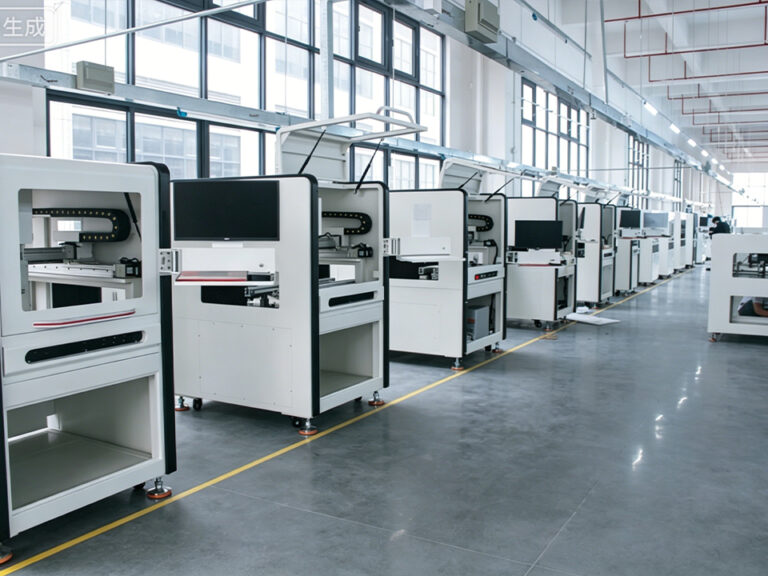
If you don’t have internal experience, steal proven layouts from vendors that build full lines. I’d start by reviewing their turnkey SMT line solutions and cross-checking against your actual floor constraints, not the clean CAD drawing you wish you had.
2) Electrical + signals: SMEMA isn’t “plug-and-play,” it’s “define-and-verify”
SMEMA gets treated like a magical handshake. It’s not. It’s a set of expectations that still require configuration discipline: who asserts “board available,” who asserts “machine ready,” what happens on “stop,” and what your buffers do when the mounter pauses for vision calibration.
Three words: test loops first.
A decent method is to simulate the line with only conveyors and a dumb board, then introduce machines one at a time. That’s how you avoid the classic deadlock: upstream says “board available,” downstream never says “ready,” and both sides swear they’re right.
If you run modern lines, don’t ignore Hermes either. It’s TCP/IP + XML messaging for board tracking and richer handover data than classic SMEMA. Even if you don’t deploy full digital traceability on day one, Hermes-compatible thinking improves your commissioning conversations because you’re forced to define data ownership, not just signals.
For complex flows (double pass, odd form factors, manual inserts), study a known working pattern like mixed SMT line configurations before you “invent” a layout under deadline pressure.
3) Software: CAD, libraries, and the feeder reality check
Most integration schedules lie about one thing: libraries.
You can physically install a pick and place machine in a weekend. You cannot magically build verified component data (package geometry, pickup height, vision thresholds, polarity rules) for 700 SKUs by Monday unless you already run a disciplined library system.
You need:
- A single source of truth for package data
- A feeder mapping strategy (especially if you’re mixing brands)
- A revision method for PCB data (Gerber/ODB++/IPC-2581 inputs vary)
- A plan for traceability fields if you have MES demands
This is why I like pointing new integrators to real examples and war stories. Browse the customer case library and look for what they mention indirectly: changeovers, training, scrap, and rework loops. That’s where the pain lives.
4) Process: line balancing isn’t a vibe, it’s math
Line balancing means you identify the bottleneck cycle time and decide whether to fix it with:
- programming (optimize head travel, feeder arrangement, gang pickup logic),
- process (print speed, squeegee pressure, SPI feedback),
- hardware (dual-lane, buffer capacity, another mounter, faster reflow),
- or product strategy (panelization, DFM tweaks).
And yes, the macro market pressure is real. Eurostat reported sold production of high-tech products rising to €414 billion in 2024, and high-tech products represented a meaningful share of extra-EU trade. Translation: more volume, more variants, more schedule stress, less tolerance for integration sloppiness. Eurostat high-tech production & trade. (European Commission)
Commissioning: what I’d demand before I sign off
If your integrator tells you “commissioning takes two days,” ask them what they mean. Do they mean power-on? Or do they mean stable production at target FPY with documented recovery procedures?
I’m blunt about this: commissioning is not successful until the line survives bad inputs. Wrong board width. Feeder empty. Vision miss. SPI reject. Reflow queue full. Network hiccup. Operator hits E-stop. And then you restart cleanly.
Here’s a practical checklist you can use in your next “pick and place machine commissioning” meeting.
| Integration Area | What usually breaks | Fast validation test | What “good” looks like |
|---|---|---|---|
| SMEMA interface setup | Deadlock between upstream/downstream ready/available | Run 50 empty boards through conveyors only | No stacking, no alarms, clean stop/start behavior |
| Conveyor interface configuration | Passline mismatch, rail pinch, sensor misread | Measure passline + run min/max board width | No edge scrape, no random “board present” ghosts |
| Data handover (Hermes/MES) | Wrong board ID, missing lane data | Inject known IDs + verify downstream receives | Traceability fields match physical flow |
| Placement program migration | Wrong rotation/origin, vision threshold mismatch | Place 20 boards, AOI compare against golden | Stable centroid accuracy, no systematic offset |
| SMT line balancing | New bottleneck appears (often printer or AOI) | Time each process step for 1 hour run | Bottleneck is known and acceptable, buffers sized |
| Safety + service access | Interlocks bypassed, unsafe service habits | Simulate jam + require safe clearing procedure | LOTO and interlocks respected, no “quick hacks” |
If you need a structured path (especially for first-time teams), I’d lean on vendor frameworks like training and after-sales support instead of improvising “tribal knowledge” that disappears when your best technician quits.
Where projects go financially sideways
People under-budget three buckets:
- Engineering time (libraries, verification, line debugging)
- Consumables + spares (nozzles, belts, filters, vacuum lines, sensors)
- Opportunity cost (lost throughput during a shaky ramp)
Porsche Consulting flagged that the European EMS workforce rose by 14,000 in 2023 to 254,000, with the sector expected to grow (they cite 6.7% CAGR to 2030). That’s not just optimism — it implies continuing competition for skilled process engineers, meaning your integration plan must be simpler, more documented, and less dependent on “one wizard.” Porsche Consulting, Oct 2024. (porsche-consulting.com)
FAQ
What is pick and place machine integration?
Pick and place machine integration is the controlled process of installing a new or replacement mounter into an existing SMT line so it mechanically transfers PCBs correctly, communicates board handoff status via interfaces like SMEMA or Hermes, and runs stable production programs with verified yield, takt time, and restart behavior after stoppages. In practice, it’s equal parts mechanics, signals, data, and process discipline. If you skip any one, you get a “running” line that still bleeds downtime.
What does SMT line integration include beyond installing the machine?
SMT line integration includes aligning passline height and conveyor geometry, configuring upstream/downstream handshakes (often SMEMA), validating board transport sensors, synchronizing software data like board width and product IDs, and re-balancing the full line’s cycle time so the new machine doesn’t create hidden bottlenecks or chronic buffer jams. Installation is the easy day. Integration is the hard month.
Is SMEMA interface setup enough for modern SMT lines?
SMEMA interface setup is a basic machine-to-machine signal handshake used to transfer boards and coordinate “ready/available” states, but it does not carry rich board data, lane metadata, or traceability fields, so many modern lines pair SMEMA-style control with higher-level data systems (MES) or protocols like Hermes for better transparency. SMEMA can work fine. It just won’t save you from bad definitions or sloppy testing.
How long does pick and place machine commissioning usually take?
Pick and place machine commissioning is the verification phase where the installed machine and the full SMT line prove stable production under normal and fault conditions, which typically means transport validation, program verification, AOI correlation, and documented recovery steps—not just powering on and placing parts. For a high-mix line with real libraries and AOI gates, plan in weeks, not days. If someone promises “48 hours,” demand their test plan in writing.
What causes conveyor interface configuration problems after a retrofit?
Conveyor interface configuration problems usually come from passline height mismatch, incorrect rail width calibration, inconsistent sensor logic (false “board present”), and transport speed/acceleration settings that don’t match upstream printers or downstream buffers, which creates intermittent jams that look random but repeat under load. Measure passline. Validate sensors. Then tune transport under real throughput, not a single board demo.
How do you balance an SMT line after adding a new pick and place machine?
SMT line balancing is the step where you measure each process cycle (print, SPI, placement, reflow entry, AOI) and adjust programs, buffers, or equipment so the slowest step becomes a known, acceptable bottleneck rather than an accidental choke point created by the retrofit. Start with timing data over at least an hour of steady run. Then move feeders, optimize head paths, or resize buffers based on what the numbers say.
Conclusion
If you’re planning an SMT line retrofit and you want fewer surprises, start by comparing your layout against proven patterns and support models: check the prototype and small-batch line options and the turnkey SMT line solution approach, then push questions to a real engineer—not a brochure. When you’re ready, use the contact page for integration support and ask for a commissioning test plan upfront. That one document tells you whether you’re buying uptime or buying hope.