Cameras lie sometimes.
I have seen production engineers treat a sharp image like a signed confession, when in reality it is just a negotiated compromise between lighting angle, nozzle vibration, lens distortion, component reflectivity, board color, feeder repeatability, and software assumptions that nobody has audited since commissioning. So what exactly is the machine deciding?
Real-Time Image Processing is the live conversion of captured production images into machine decisions, usually within milliseconds, so a pick and place system can verify component identity, orientation, offset, polarity, lead condition, fiducial position, and placement viability before the board moves downstream.
That sounds clean. It is not.
In SMT, the real argument is not whether a camera can “see” the component. The real argument is whether the image processing pipeline can make a placement decision fast enough, repeatably enough, and with enough documented tolerance control that operators stop treating false rejects as background noise. Once false rejects become normal, the line is already lying to itself.
The industry data backs the pressure. The International Federation of Robotics reported 4,281,585 industrial robots operating in factories worldwide in 2023, up 10%, with annual installations above 500,000 units for the third consecutive year. Seventy percent of new robot deployments in 2023 were in Asia. That matters because electronics factories are not buying vision as a feature anymore; they are buying uptime, density, and automated judgment. (IFR Federação Internacional de Robótica)
For SMT buyers comparing máquinas de recolha e colocação, the camera is not a camera. It is a gatekeeper.
What actually happens between capture and placement decision
A proper computer vision workflow starts before the image exists. Lighting is engineered. Fiducials are chosen. Component libraries are built. Nozzle behavior is calibrated. Feeder pockets are profiled. Then the machine captures an image and runs it through a decision chain that usually looks like this:
- Image capture from upward-looking, downward-looking, or side-view cameras
- Preprocessing: denoising, contrast correction, geometric correction
- Feature extraction: edges, pads, leads, balls, package outline, polarity marks
- Registration against CAD, Gerber, feeder, and component library data
- Offset and rotation calculation
- Confidence scoring
- Placement decision: mount, correct, retry, reject, or stop
Here is the hard truth: most bad implementations fail before AI enters the conversation. They fail because the lens is dirty, the illumination is lazy, the part library is copied from a similar package, or the process engineer never checked whether the “acceptable” offset is still acceptable after reflow.
A 2024 study on real-time defect detection in electronic component assembly described capturing images from pick-and-place machines in the interval between component pick-up and mounting, then using in-line detection to address defects before placement. That is the meaningful shift: inspection is no longer only post-placement AOI; it is becoming pre-placement permission. (MDPI)
É por isso que Sistemas de inspeção SMT and placement equipment should not be evaluated as separate islands. The placement head, feeder, nozzle, camera, AOI, SPI, and MES all create one decision loop. Break one link, and the board still moves. It just moves with hidden risk.
The capture layer: where the first mistake usually starts
Image capture processing sounds passive. It is not.
A machine vision system has to freeze a moving industrial event: nozzle picks a component, the component may shift under vacuum, the head accelerates, the camera captures, the software estimates geometry, and the controller decides whether correction is possible. In high-speed mass production, this sequence has to happen without turning the machine into an expensive microscope.
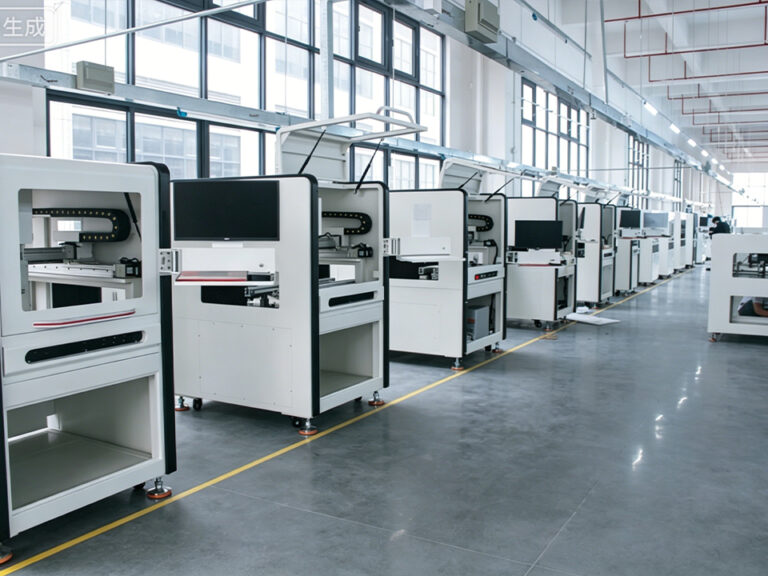
This is why high-speed SMT production lines punish weak vision design. A prototype line may tolerate another inspection pass. A mass-production line will turn that pass into lost throughput, operator overrides, and arguments over whether the “machine is too sensitive.”
But here is my unpopular opinion: sensitivity is rarely the enemy. Poorly mapped sensitivity is.
A vision system should not merely detect deviation. It should classify deviation by production consequence. A 30-micron rotational error on one package may be harmless. The same error on a fine-pitch QFN, micro-BGA, or 0201 passive near dense copper may be a real defect seed. The system needs component-specific rules, not generic green/red theater.
Edge image processing is now the sane default
Edge image processing means image analysis happens near the machine, not after raw image streams are pushed to a remote server. In SMT, that matters because latency is not a spreadsheet issue; latency is a placement issue.
Cloud-heavy inspection sounds attractive in a boardroom. On the floor, it often creates dependency chains that production managers quietly hate: network delay, data export risk, model version drift, remote debugging, and unexplained decision timing. Edge inference keeps the decision close to the actuator.
The AI governance side is catching up. NIST’s AI Risk Management Framework 1.0, released in January 2023, frames AI risk management around trustworthy system behavior rather than model hype alone. That is exactly how factory vision should be discussed: not “does it use AI,” but “can we govern, measure, monitor, and challenge its decisions?” (NIST)
For buyers planning a full line, the safest structure is a solução de linha SMT chave na mão where capture, inspection, placement, reflow feedback, and operator escalation are designed as one system. Buying isolated machines and hoping the data will behave later is how factories create expensive blame loops.
Rule-based vision is not dead. Bad rule-based vision is.
I do not buy the lazy story that deep learning replaces classical image processing. In SMT, the best real-time image processing techniques often combine both.
Rules are still excellent for fiducial recognition, package outline checks, contrast thresholds, geometry measurements, barcode reading, and deterministic go/no-go criteria. AI becomes useful when variation is messy: unusual solder appearance, package texture, glare, contamination, subtle deformation, or mixed defect classes where a fixed threshold becomes brittle.
A 2023–2024 Bosch-related manufacturing defect detection paper showed a tensor convolutional neural network reaching comparable performance with up to 15 times fewer parameters and 4% to 19% faster training times than an equivalent CNN in a real defect-detection application. Translation: smaller models are not a downgrade when the production constraint is speed, stability, and deployability. (arXiv)
Small models win often.
The bad version of AI vision is a black-box classifier bolted onto a dirty process. The good version is a measurable inspection layer that knows when it is uncertain, logs the image, records the decision, and lets engineers compare machine judgment against downstream AOI, SPI, X-ray, electrical test, and field returns.
Placement decision logic: the part nobody wants to document
A placement decision is not one decision. It is a stack of smaller judgments:
| Decision Stage | What the System Checks | Common Failure Mode | Better Buyer Requirement |
|---|---|---|---|
| Component identity | Package outline, markings, feeder source, library match | Wrong reel accepted because geometry is similar | Require feeder verification plus visual confirmation |
| Orientation | Polarity mark, pin-one, notch, text direction | Rotated IC passes outline check | Require polarity-specific vision recipes |
| Pickup quality | Centering, vacuum stability, tombstoned part in nozzle view | Component shifts during travel | Log pickup offset before correction |
| Placement offset | X/Y/theta correction from camera data | Generic tolerance used for all packages | Component-specific tolerances by footprint class |
| Surface condition | Bent leads, missing balls, contamination, damaged package | Camera sees outline but misses defect | Add defect-class detection, not only geometry |
| Confidence score | Probability or rule confidence before mount | Low-confidence results hidden from operators | Require confidence thresholds and audit logs |
| Escalation | Retry, reject, stop, operator review | Operators override until alarms mean nothing | Define override permissions and review cadence |
The fastest machine is not the one that places blindly. It is the one that rejects early, corrects intelligently, and does not waste reflow, AOI, repair labor, or customer trust on defects it could have caught in flight.
É também aqui que linhas SMT para protótipos e pequenos lotes need different settings from high-volume lines. In prototype work, flexibility and library editing matter more. In volume work, recipe lockdown, traceability, and repeatable takt time matter more. Same camera, different business logic.
The legal and compliance problem nobody in sales likes to mention
Factory image data is not always “just parts.” It can include operator hands, badges, faces reflected in glossy surfaces, workstation screens, QR codes tied to customers, and production data that reveals sensitive supply-chain activity.
In Europe, Regulation (EU) 2024/1689, the AI Act, set harmonized rules for AI systems, and the European Commission notes that prohibitions on certain AI practices became effective in February 2025, including real-time remote biometric identification for law enforcement purposes in publicly accessible spaces. Industrial SMT inspection is usually not that use case, but the message is obvious: real-time visual decision systems are now regulatory objects, not harmless cameras. (EUR-Lex)
So yes, your placement camera needs a data policy.
Keep raw images only as long as they have process value. Mask human data where possible. Version the model. Record the recipe. Track false accepts and false rejects. Make the machine explain why it rejected a component, even if the explanation is only “polarity confidence below threshold” or “lead-edge deviation above tolerance.”
For public proof points, casos de clientes matter more than glossy brochures. Ask for before-and-after defect escape rates, false reject rates, placement accuracy data, and downtime impact. If a supplier cannot show the numbers, assume the numbers are not flattering.
What I would demand before buying
I would not buy a real-time image processing system without seeing these five things:
A live demo using ugly boards, not showroom boards.
A component library audit process that shows who can edit tolerances, when, and why.
An edge-processing architecture that keeps placement decisions local.
A reject-image database that engineers can review without begging the supplier.
A clear link between vision results and downstream process data from SPI, AOI, reflow, and electrical test.
The industry keeps pretending vision is about pixels. It is not. It is about whether a production line can trust a machine-made decision at speed.
And trust is earned in logs.
FAQs
What is real-time image processing in SMT manufacturing?
Real-time image processing in SMT manufacturing is the immediate analysis of camera-captured images from pick-and-place, AOI, SPI, or handling equipment so the machine can detect identity, orientation, offset, polarity, and visible defects before the process continues. It turns image data into a machine action, not merely a report.
In practice, that action may be correction, retry, rejection, alarm, recipe adjustment, or permission to place the component. The best systems connect camera data with CAD, feeder setup, component libraries, and inspection history.
How does real-time image processing work in a pick and place machine?
Real-time image processing works by capturing component or board images during pickup, travel, or placement, then running preprocessing, feature recognition, geometric measurement, confidence scoring, and decision rules fast enough to guide the placement head. The machine compares what it sees against expected package, footprint, fiducial, and tolerance data.
This is why lighting, calibration, lenses, nozzles, feeders, and software recipes all matter. A weak mechanical setup cannot be saved by a fancy algorithm forever.
Is AI better than traditional image processing for placement decisions?
AI is better than traditional image processing when the defect pattern is variable, subtle, or difficult to describe with fixed thresholds, but rule-based methods remain better for many deterministic geometry checks. The strongest SMT systems use both: rules for measurable structure, AI for messy visual variation.
Do not buy “AI” as a label. Buy measured performance: false reject rate, false accept rate, cycle-time impact, model version control, and auditability.
Why is edge image processing important for SMT lines?
Edge image processing is important for SMT lines because placement decisions must happen near the machine, with minimal latency, stable uptime, and fewer dependencies on external networks or cloud services. It keeps inspection logic close to motion control, which helps protect takt time and decision reliability.
Remote analytics can still be useful for dashboards, training, and fleet-level improvement. But the mount-or-reject decision should not depend on a network round trip.
What metrics should buyers ask for before trusting automated placement decisions?
Buyers should ask for placement accuracy, false accept rate, false reject rate, image-processing latency, recipe change history, component-library coverage, reject-image traceability, and downstream correlation with AOI, SPI, X-ray, and electrical test results. These numbers reveal whether the system improves production or simply creates better-looking alarms.
I would also ask for performance by package type: 0201, 01005, QFN, BGA, connector, odd-form, shield can, LED, and polarized components. Average accuracy hides expensive edge cases.
Conclusão
If you are evaluating vision-guided placement, do not start with the camera spec. Start with the decision you need the line to make. For equipment selection, integration planning, and machine matching, review the available SMT solutions ou contactar a equipa with your board type, component mix, target CPH, and inspection pain points.